
 Mariya Abid
A QMS software quotation can look simple until two vendors use different definitions of “included.” To be particular, one may segregate pricing by user, another by module or site. Comparing the headline price alone can therefore produce the wrong shortlist.
This guide explains what drives QMS software cost, which charges appear before and after go-live, and how to compare vendors over five years. However, If your team is still deciding whether software is necessary, begin with the signs your quality system has outgrown Excel.
Quick answer: QMS software pricing depends on the licensing model, users, sites, modules, deployment, implementation scope, configuration, migration, integrations, training, validation support and ongoing service. Compare the five-year total cost of ownership rather than subscription or licence fees alone.
Why Is There No Single Average QMS Software Cost?
A one-site document-control project is not the same scope as a multi-site rollout connecting Corrective and Preventive Action (CAPA), deviations, audits, suppliers and laboratory processes. Users, records, hosting and regulatory expectations also change the effort.
For example, Spectrum pricing plans are based on both annual and monthly basis with shape based on the user needs. Segregated plans from starter, professional to enterprise needs making it easier to pick the best for you.
Which QMS Pricing Model Are You Comparing?
| Pricing model | How it works | Questions to ask |
| Per-user subscription | Recurring fee based on named, active or concurrent users. | How are occasional, read-only, supplier and administrator accounts charged? |
| Module-based pricing | Fees depend on selected workflows or application bundles. | Are dependencies included, and what will later modules cost? |
| Site or enterprise licence | Price covers a defined location, business unit or organization. | Are subsidiaries, plants, laboratories and external users inside the boundary? |
| Perpetual licence plus maintenance | Upfront licence with annual maintenance, support or upgrade charges. | Which infrastructure, upgrades and support remain the customer’s responsibility? |
| Usage or storage based | Charges change with records, transactions, storage or computing use. | What are the thresholds, overage rates and expected growth assumptions? |
What Determines QMS Licensing and Subscription Cost?
The recurring software price commonly changes with:
- Number and type of users, including external or supplier access
- Modules and workflows included in the initial scope
- Sites, legal entities, plants, laboratories and languages
- Cloud, hosted or on-premise deployment responsibilities
- Storage, retention, backup, recovery and non-production environments
- Support level, service hours and response commitments
- Contract term, renewal escalation and future expansion rates
Also, confirm whether updates are included and whether releases create additional testing, validation or configuration work.
What Is Included in QMS Implementation Cost?
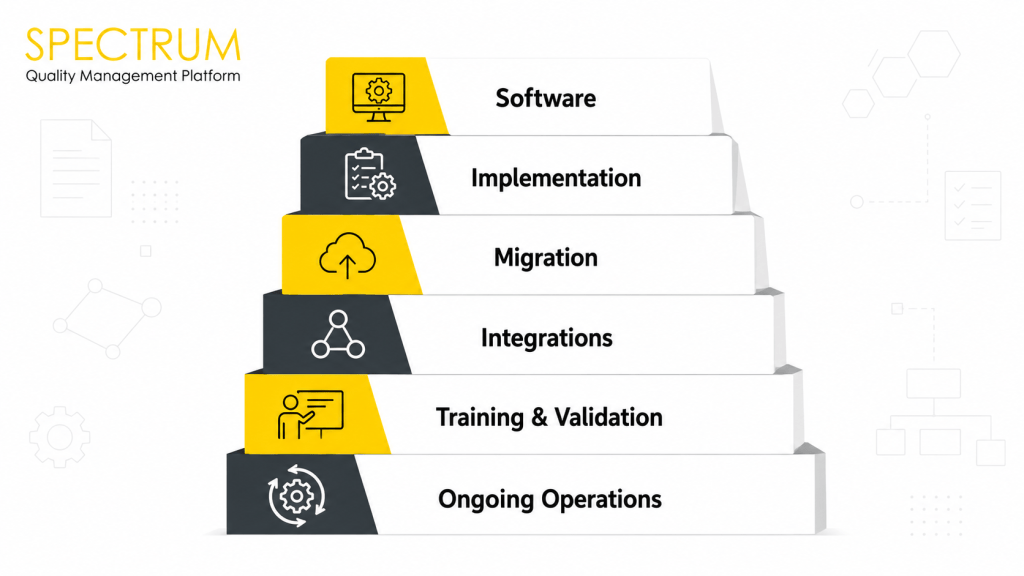
The effort required to turn licensed software into an operational system is what companies refer when they mention QMS implementation cost. It can include discovery, configuration, project management, migration, integrations, testing, validation support, training and go-live.
“Implementation included” may cover only standard setup. Confirm deliverables, assumptions, customer responsibilities, environments, migrated record types, training and go-live assistance. Enterprise Resource Planning (ERP) integration can affect cost, as can interfaces with a Laboratory Information Management System (LIMS), Manufacturing Execution System (MES) or identity service.
Regulated scope can include documented assurance or validation activities. U.S. Food and Drug Administration (FDA) Part 11 guidance explains when specified electronic records fall within Title 21 Code of Federal Regulations (21 CFR) Part 11; the FDA’s Computer Software Assurance guidance describes a risk-based approach for relevant medical-device software. Establish intended use before estimating this work.
BUILD A COMPLETE QMS COST SCOPE
See how Spectrum can be scoped around your users, sites, priority workflows, migration needs and integration requirements.
Which Hidden QMS Costs Should You Ask About?
A hidden cost is often a necessary item omitted from an early comparison. Confirm whether each item is included, optional or customer-owned:
- Data profiling, cleansing, transformation, migration and reconciliation
- Workflow configuration, reports, dashboards and approved custom development
- Interfaces, middleware, application programming interfaces (APIs) and third-party licences
- Test or sandbox environments, storage growth, backups and data export
- Validation documentation, execution support and change-related retesting
- Administrator and end-user training, refresher training and new-site rollout
- Premium support, travel, after-hours assistance and release management
- Internal project time for Quality Assurance (QA), Information Technology (IT), process owners and users
Migration is especially easy to underestimate. The article on moving quality records from Excel to an eQMS explains which records to migrate, archive, remediate or dispose off.
How Do You Calculate Five-Year Total Cost of Ownership?
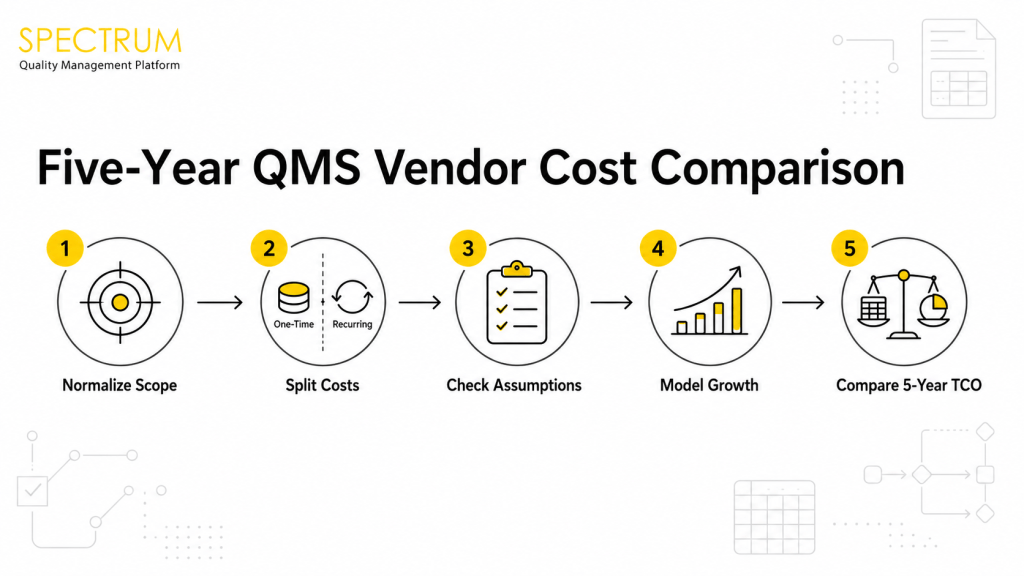
Total cost of ownership (TCO) combines acquisition, implementation and operating costs across a consistent period. A practical comparison is:
Five-year TCO = initial software and implementation + five years of recurring fees + internal operating effort + planned expansion + contingency for documented assumptions.
| Cost category | Year 1 | Years 2–5 |
| Software | Licence or first subscription term | Subscription, maintenance, renewal escalation |
| Services | Discovery, configuration, migration, integrations, testing, training | Enhancements, new workflows, upgrade or release assistance |
| Technology | Infrastructure or initial environments where applicable | Hosting, storage, backup, security tooling, additional environments |
| Internal effort | Project team, data owners, testing, training and change activities | Administration, support, governance and continuous improvement |
| Expansion | Initial users, modules and sites | Planned users, sites, languages, modules and higher usage tiers |
Use the same currency, tax treatment, escalation, growth and timeline for every vendor. The future article on calculating QMS software ROI will compare benefits with this cost baseline.
How Should You Compare QMS Vendor Quotations?
Build one comparison sheet and require every vendor to answer the same commercial questions. This extends the QMS software selection framework therefore functionality must be compared against evidence, while cost must be compared against equivalent scope.
| Comparison field | Record for every vendor |
| Commercial scope | Users by type, modules, sites, environments, storage and contract term |
| One-time charges | Implementation, configuration, migration, integration, validation support and training |
| Recurring charges | Subscription or maintenance, hosting, support, storage and third-party fees |
| Customer responsibilities | Internal resources, data preparation, testing, procedures, training and administration |
| Change and growth | Renewal escalation, extra users/sites/modules, upgrades, exports and exit assistance |
| Assumptions and exclusions | Dependencies, limits, optional items and activities not priced |
Remember, Until exclusions are priced, do not award the lowest-cost score . Additionally, examine the payment schedules, price protection, service levels, data ownership, export rights and expiring discounts.
Where Does Spectrum Fit in a QMS Pricing Review?
Spectrum Quality Management Software should be evaluated against the same normalized scope and five-year TCO method as every shortlisted platform. Define the workflows you need now, the sites or modules likely to follow, and the services required to make those workflows operational. A module-level review—such as E-Docs and Document Control—can make the boundary clearer than a generic platform quote.
The goal is not to choose the smallest number. It is to understand what the number buys, what remains with your internal team and how the commercial model behaves as your quality operations scale. For broader context, explore how QMS supports smart manufacturing—then keep the pricing comparison tied to the actual scope being purchased.
COMPARE SPECTRUM WITH A CLEAR COST BASELINE
Request a tailored demonstration and discuss the users, workflows, services and future expansion assumptions that should appear in your QMS cost comparison.
Conclusion
The answer to “How much does QMS software cost?” is a defined scope expressed through one-time, recurring and internal costs. Normalizing users, modules, sites, services and growth makes quotations easier to compare and prepares the next steps: a QMS implementation roadmap and evidence-based business case.
Frequently Asked Questions
QMS software cost varies with users, modules, sites, deployment, implementation, migration, integrations, training, validation support and service. Request a scoped quotation and compare five-year TCO instead of relying on a universal average.
Pricing may include a license or subscription, selected modules, hosting, updates and a defined support level. Implementation, migration, integrations, training, validation assistance, storage or extra environments may be separate, so inclusion must be confirmed.
Commonly missed items include data cleansing and migration, configuration, integrations, third-party licenses, testing environments, storage growth, validation activities, training, premium support, upgrades and internal project or administration time.
Not automatically. Subscription reduces upfront software expenditure but continues over time. A perpetual license may require infrastructure, maintenance and upgrade costs. Compare both models using the same five-year scope and assumptions.
Give every vendor the same user definitions, modules, sites, environments, migration scope, integrations, service levels, timeline and growth assumptions. Separate one-time, recurring and internal costs, then record exclusions and dependencies beside the total.
