
 Mariya Abid
Buying a Quality Management System is only the beginning of a digital quality transformation. The success of an electronic quality management system implementation depends on how effectively an organization translates its existing quality processes into controlled digital workflows.
A successful QMS software implementation requires more than configuring software. It requires alignment between quality teams, IT stakeholders, process owners and business leadership. Planning, workflow design, data migration, integrations, validation, training and adoption all influence whether the system delivers long-term value.
After identifying the need for a digital quality platform through the earlier stages of the QMS selection journey, organizations must now answer a practical question: How can the system be deployed successfully with minimal disruption?
WHAT IS QMS IMPLEMENTATION?
QMS software implementation is the structured process of configuring, validating and deploying quality management software according to an organization’s workflows, compliance expectations and operational objectives.
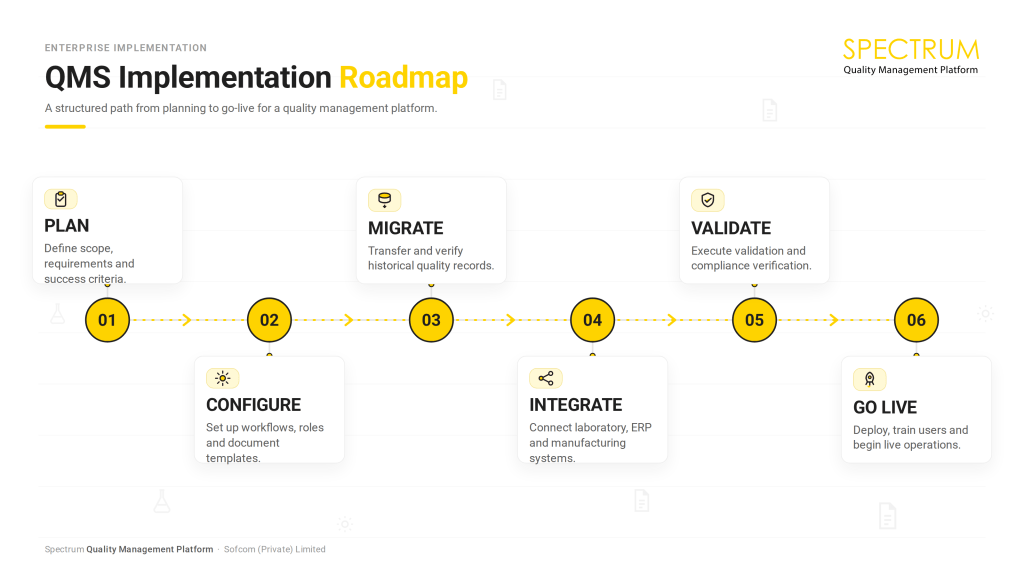
A complete implementation roadmap typically includes:
- Project planning and scope definition
- Workflow configuration
- Quality record migration
- System integration
- Validation and testing
- User training
- Go-live support
- Continuous improvement
The objective is not simply to replace paper or spreadsheets. The objective is to establish controlled digital processes that improve traceability, visibility and operational consistency.
PHASE 1: PLANNING YOUR QMS IMPLEMENTATION
Every successful QMS implementation begins with understanding the current quality environment.
Before configuration begins, organizations should define:
- Current quality processes and pain points
- Required QMS modules and workflows
- Stakeholders involved in implementation
- Compliance and validation expectations
- Integration requirements
- Success criteria after deployment
A clear implementation team usually includes representatives from Quality Assurance, Quality Control, IT, operations, compliance and business leadership.
This planning stage prevents a common implementation mistake: configuring software before understanding how teams actually work.
For organizations evaluating requirements before implementation, the earlier guide on how to choose QMS software helps define selection criteria, workflows and vendor evaluation requirements.
PHASE 2: CONFIGURING YOUR QUALITY MANAGEMENT SYSTEM
Configuration transforms business requirements into controlled digital workflows.
During this stage, organizations define:
- Document approval workflows
- CAPA processes
- Deviation management routes
- Change control approvals
- User roles and permissions
- Reports and dashboards
A configurable QMS allows organizations to align the system with existing procedures while maintaining controlled processes.
The goal is not to recreate every manual step digitally. The goal is to improve processes by reducing unnecessary approvals, improving visibility and creating consistent workflows.
PHASE 3: QMS DATA MIGRATION
Data migration is one of the most underestimated parts of electronic quality management system implementation. Organizations often have years of quality records stored across spreadsheets, shared folders, emails and legacy systems.
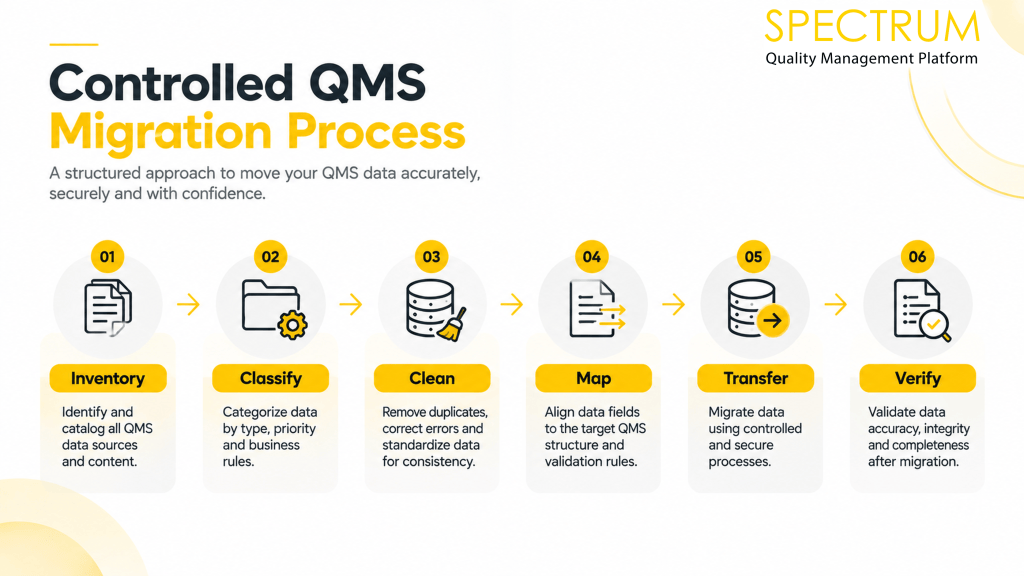
A controlled QMS data migration approach should include:
- Inventory — identify existing records and determine what information exists.
- Classification — separate active records, historical records and unnecessary data.
- Cleaning — correct inconsistencies and prepare records for transfer.
- Mapping — define how existing information fits into new workflows.
- Transfer — move approved records into the new system.
- Verification — confirm accuracy, completeness and accessibility.
Poor migration planning can create compliance risks and reduce user confidence. The supporting guidance on migrating quality records from Excel to an eQMS explains how organizations can prepare information before moving into a digital environment.
PHASE 4: SYSTEM INTEGRATION
Modern quality environments rarely operate in isolation.
A QMS may need to connect with:
- Enterprise Resource Planning (ERP) systems
- Laboratory Information Management Systems (LIMS)
- Manufacturing Execution Systems (MES)
- Identity and access management systems
Connected systems reduce manual data transfer and help maintain consistent information flow.
Spectrum Quality Management Platform connects QMS and LIMS capabilities within one quality environment and can integrate with Manifold MES for connected quality and manufacturing workflows.
This connected approach helps manufacturers link quality processes, laboratory information and production activities more effectively.
PHASE 5: QMS VALIDATION
Validation confirms that the implemented system performs according to intended requirements.
For regulated industries, organizations should establish a risk-based validation approach based on intended use.
The FDA guidance on 21 CFR Part 11 explains considerations for electronic records and electronic signatures in regulated environments.
The FDA Computer Software Assurance guidance also promotes a risk-based approach for establishing confidence in software used within production and quality systems.
Validation activities may include:
- Requirements review
- Risk assessment
- Configuration verification
- Functional testing
- User acceptance testing
- Approval documentation
Following recognized approaches such as ISPE GAMP 5 can help organizations structure computerized system validation activities.
PHASE 6: TRAINING AND CHANGE MANAGEMENT
Technology adoption depends on people.
Even a well-configured QMS can fail if users do not understand the workflows or the benefits of the new system.
Effective QMS user adoption requires:
- Role-based training
- Updated procedures
- Clear communication
- User support after deployment
- Feedback collection
Quality management software training should focus on helping users understand how their daily responsibilities improve through controlled digital processes.
QMS GO-LIVE AND CONTINUOUS IMPROVEMENT
Go-live is not the end of implementation. It is the beginning of operational improvement.
After deployment, organizations should monitor:
- Workflow adoption
- User engagement
- Process cycle times
- Reporting effectiveness
- Improvement opportunities
A successful QMS implementation roadmap should allow organizations to expand capabilities as their requirements evolve.
Common QMS Implementation Mistakes to Avoid
Organizations can reduce implementation risk by avoiding common mistakes:
- Lack of clear ownership
Implementation requires collaboration between departments.
2. Migrating unnecessary data
Not every historical record requires migration.
3. Ignoring validation requirements
Regulated organizations should define validation expectations early.
4. Underestimating training
User adoption directly affects system success.
5. Treating go-live as the final milestone
Continuous improvement is essential after deployment.
How Long Does QMS Software Implementation Take?
There is no universal QMS implementation timeline. Duration depends on factors including:
- Number of modules
- Number of users
- Locations involved
- Integration requirements
- Data migration volume
- Validation scope
A small implementation may require a different approach from a multi-site enterprise deployment.
The right implementation partner should define a realistic roadmap based on actual business requirements rather than promising a fixed deployment period.
Request a Spectrum implementation Demo
Understand how Spectrum QMS, Spectrum LIMS and Manifold MES can support your digital quality transformation.
Frequently Asked Questions
The timeline depends on system scope, modules, integrations, migration requirements and validation activities.
The main stages include planning, configuration, migration, integration, validation, training and go-live.
Implementation typically involves Quality, IT, operations, compliance and business stakeholders.
Organizations should inventory, classify, clean, map, transfer and verify records before moving them into an eQMS.
Organizations should prioritize workflows that address the most critical quality processes and operational challenges.
