
 Mariya Abid
A planner releases an order. An operator starts the first step. A material issue stops the line, and quality must approve a check before work continues. The information exists somewhere, but can the team connect those events while the order is still active? That is the buying question behind MES software. A manufacturer needs more than another screen of shop-floor data; it needs a dependable path from the plan to the work, the response, and the final record.
A manufacturing execution system helps organize that path. It relates orders, people, materials, equipment, process steps, checks, and actual outcomes. When an event changes the course of production, an authorized team can see the affected work, follow the applicable workflow, and document its decision. The result depends on configuration, process design, integration, and adoption. The software alone does not guarantee a faster line or a compliant site.
This article completes the cluster’s sequence. The earlier article on shop-floor visibility asks whether teams can trust current status. The next, on production data collection, asks whether a value has the time, source, and order context needed for a decision. The discussion of production control shows how authorized teams act, verify, and close. Here we examine how MES can connect all three requirements and what a buyer should test before choosing a platform.
What does MES software actually do?
MES software coordinates and records production execution between business planning and the shop floor. An ERP system may provide demand, inventory, and planned work. Machines, sensors, and operators produce actual events. MES relates the plan to the specific order, step, resource, and result, then supports the workflows that govern execution. Its scope varies considerably by vendor and industry; a product name does not prove every function is included.
The distinction reflects ISA-95’s enterprise and control integration model, which describes manufacturing operations activities and their information exchanges. ISA-95 provides a useful evaluation language, but it does not prescribe a particular product or guarantee that two applications will integrate without design work. Siemens’ manufacturing execution overview likewise frames visibility and traceability as MES concerns; the actual depth of either capability should be demonstrated against a buyer’s process.
How does MES turn data into production control?
The connection is easiest to see through one order. First, the system receives or creates the production identity: order, product, route, quantity, and current revision. Next, people or connected equipment capture what actually happens at the relevant point in the process. The system ties each event to that identity, making current work visible without relying on a handwritten shift summary. Then the production workflow guides or restricts the next action according to the configured permissions and rules. Finally, it retains the results, approvals, and exceptions as an execution history.
That sequence—data capture, visibility, execution, control, traceability—is the architecture to test. A live status card is helpful, but it is not enough if an operator cannot find the applicable instruction or a supervisor cannot identify who owns a hold. Equally, an electronic batch record collected only after the shift may be too late to support an intervention. Ask a vendor to trace one abnormal event across the entire sequence.
Connect shop-floor data to the right production context
A downtime duration, temperature reading, or quantity has limited operational value by itself. MES production tracking becomes useful when the event includes the relevant order, batch or lot, process stage, equipment, shift, and time. That context lets a supervisor distinguish a short stop on one line from a recurring interruption across several orders. It also helps quality and engineering review which material or product may have been affected.
This is a data design problem as well as a software problem. NIST’s manufacturing data infrastructure program focuses on collection, transformation, traceability, and interoperability. A buyer should therefore ask which sources feed the MES, whether events arrive automatically or through controlled operator entry, how identifiers match, and what happens when a source is unavailable.
Show current work at the speed of the decision
How does MES provide real-time production visibility? By updating the state of work when a relevant event occurs, then making that state available to the people who can respond. “Real time” needs a defined operational window. A quality hold on an active batch may demand immediate attention, while a weekly loss analysis can tolerate slower aggregation. Specify the decision and acceptable delay before accepting a vendor’s claim of live visibility.
The useful screen links status to action: which order is waiting, why, since when, what has already happened, and who owns the next step. If a dashboard gives only a color and a percentage, the team may still need to reconstruct the event from calls and spreadsheets. A shop floor MES should make it possible to move from an alert to the relevant execution context.
Guide execution and manage exceptions
Once the order is active, manufacturing execution software can show approved steps, assigned resources, material requirements, and in-process checks. A configured exception route can pause or hold work, notify a responsible role, capture the reason, and record the authorized decision to continue. The controls must match the site’s operating procedures. A vendor demonstration should include a missing material, a failed check, or an equipment interruption rather than only a smooth run.
This is where real-time production control becomes tangible. The system should help the operator understand what to do next and help a supervisor see what needs intervention. It should also preserve the original observation when someone corrects a data entry. Permission, escalation, electronic signature, and hold behavior require precise review in the proposed configuration, especially in regulated operations.
Retain a traceable account of what happened
How does MES improve manufacturing traceability? It links execution events and relevant resource identities to the same order or batch: materials assigned and consumed, equipment used, steps performed, process values captured, quality checks, exceptions, and approvals. That gives reviewers a route through the actual production history. It does not mean every sensor value needs to appear in a single record or that software automatically establishes regulatory compliance.
The importance of trustworthy records is addressed directly in NIST’s recommendations on traceability and trustworthiness of manufacturing-related data. Ask how the proposed MES preserves timestamps, origin, amendments, and relationships between data points. In batch manufacturing, evaluate whether a reviewer can see unresolved items before closure; article on electronic batch records versus paper records offers additional process context.
How should MES integrate with ERP and quality systems?
ERP typically owns business planning and inventory transactions; an MES manages and documents what happens during production. An integration may bring approved orders or item data into the execution layer and return actual production, material, and completion information. The exact source of truth, direction of each transaction, timing, failure handling, and reconciliation rule should be decided before a purchase. A diagram with arrows is not an integration specification.
The distinction between the layers is explained further in MES vs ERP vs SCADA. Where quality and lab decisions affect production, determine whether a QMS or LIMS sends a usable release status, how a hold reaches the active order, and what happens if the systems disagree. ISA-95 provides a model for discussing those information exchanges, while the exact mappings remain a project design task.
Take one example: ERP releases an order for a batch; MES presents the approved production steps and captures material consumption; an in-process sample goes to the laboratory; quality reviews the result; MES receives the status needed to permit or hold the next step; actual execution data returns to the appropriate enterprise systems. Every handoff needs an owner, a matching identifier, and a defined response if the message fails. Confirm those details in a scenario-based demonstration.

Request a Manifold – MES Demo.
Bring one real order, one exception, and your ERP and quality handoffs. Explore the route from released plan through execution, hold or intervention, verification, and closure.
What should manufacturers compare in an MES evaluation?
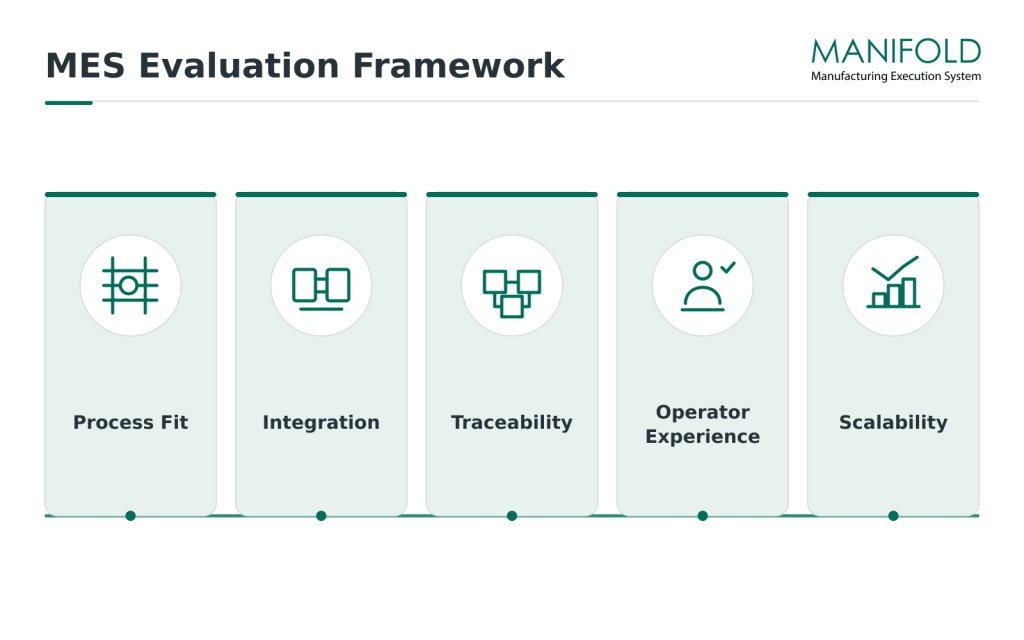
Start with process fit rather than a feature count. Can the platform represent your order structure, batch or discrete workflow, material identities, equipment, and site-specific approval points? Can an operator use it during a shift without bypassing it to get the job done? Can a supervisor identify an overdue decision? If you have multiple plants, ask which rules are common and which can differ by site.
Then test integrations with concrete examples. Request field-level mappings for one order and one production result. Simulate a duplicate message, a rejected transaction, a network interruption, and a correction. Ask where the system keeps the original value and who can change it. For any required electronic signature or audit trail, request a demonstration of permission boundaries, record access, and review workflow rather than accepting a checklist tick.
Finally, compare implementation and ownership: process discovery, configuration responsibilities, validation or qualification where applicable, data migration, operator training, support, and changes after go-live. A vendor may offer suitable capabilities yet propose an unrealistic deployment path. A useful scorecard weights the requirements that protect your highest-risk orders, not the longest list of optional modules.
Where Manifold fits the evaluation
Manifold MES is a manufacturing execution platform. It includes planning and scheduling, material assignment and consumption, process-value capture, in-process checks, hold and resume workflows, electronic records, monitoring, and integration with Spectrum QMS and LIMS where relevant. Evaluate the exact modules, interfaces, permissions, and deployment arrangement proposed for your site. Treat capability descriptions as questions to demonstrate, not as guaranteed outcomes.
For a public customer example, AGP Limited’s Manifold announcement describes its selection of the system to digitize and control manufacturing execution from planning through electronic batch records and batch closure. It is evidence of the announced project scope, not a published quantified result. For a broader view of connected manufacturing, read MES and Industry 4.0 article.
The decisive question for your team is whether the proposed configuration can take an actual production event through the whole chain: identify it, show its effect on the current order, route the next authorized action, verify the outcome, and leave an intelligible record. That test separates a useful MES proposal from a polished feature presentation.
Compare Your Production Requirements
Download the MES Evaluation Scorecard and score vendors against process fit, data capture, operator experience, integration, exception response, quality checks, traceability, and implementation support. Use one real production scenario for every high-priority criterion.
Frequently Asked Questions
It connects production plans with shop-floor execution, helping teams guide work, capture actual events, manage exceptions, and retain a usable execution history. Capabilities depend on the product and implementation.
MES can connect current status to defined actions, owners, checks, and approvals. Assess improvement against your own baseline for response time, missing records, and execution consistency.
An interface typically exchanges orders, master data, material or inventory information, and actual production results. The direction, timing, system of record, and failure handling must be specified for each transaction.
Depending on configuration: order and stage status, material assignments and consumption, equipment, quantities, process values, downtime, quality checks, exceptions, approvals, and completion records.
It relates relevant production events, people, resources, and decisions to an order or batch. Traceability quality still depends on accurate identity, capture, permissions, and record governance.
Test one complete normal and one abnormal order. Compare process fit, usability, integrations, exception routes, auditability, security, rollout work, and support with weighted criteria.
