
 Mariya Abid
The dashboard says a batch is behind schedule. Everyone can see the red status. Yet the team still has to call the line, check whether the right material arrived, find out who can approve the next step, and reconstruct what changed. The problem is no longer a lack of visibility. It is the gap between seeing an event and managing the work that follows.
Production control closes that gap. It gives authorized people a defined way to release work, follow approved steps, respond to exceptions, verify results, and finish with a reliable execution record. For a production manager, that means fewer decisions depend on a chain of calls and spreadsheets. For an operator, it means knowing which instruction and status apply to the job in front of them.
This is the next step in the cluster. Our discussion of shop floor visibility explains why status is often difficult to trust. The article on production data collection shows why data needs the right time, order, equipment, and process context. Once those foundations exist, the question changes: what can the team actually do with the information?
What Is Production Control?
Production control is the coordinated management of production work as it moves from an approved plan into execution and completion. It includes releasing the right order, guiding work through defined steps, tracking resources and progress, handling interruptions, checking quality requirements, and recording what happened. Its exact scope varies by industry, site, and process. The practical test is whether the team can act on a current condition through an authorized, traceable workflow.
That definition aligns with the manufacturing operations domain described by ISA-95, which models activities and information exchanges between business planning and plant operations. It also reflects NIST research on shop floor controllers, which distinguishes decision-making and execution from merely displaying production data. These sources describe frameworks; they do not imply that every plant needs the same software configuration.
Production Monitoring Versus Production Control
Production monitoring tells a supervisor that a line stopped at 10:42. Production control adds the next operational steps: record a reason, route the interruption to the right owner, decide whether the job can continue, and retain that decision with the order. A monitor can show that a quality check is overdue. A controlled production workflow can prevent an unauthorized next step until the responsible person completes the check, where that gate is configured for the process.
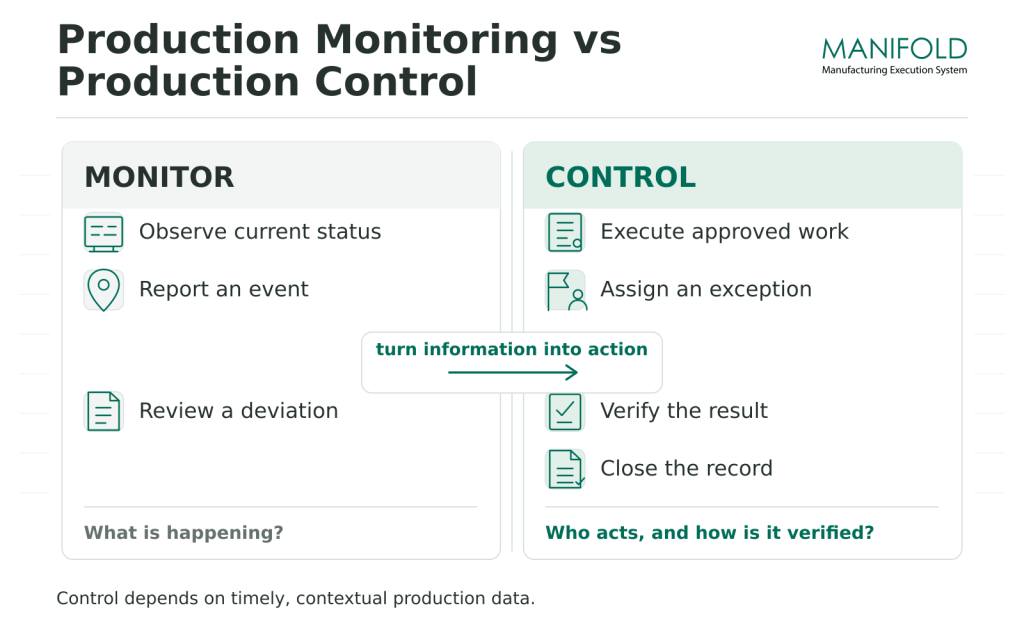
| Question | Monitoring answers | Control adds |
| What is happening? | Current state, output, alarms | Who owns the response and what action is allowed? |
| What changed? | Time and reported event | Reason, authorization, action and evidence |
| Is work complete? | Progress indicator | Verification and a closed execution record |
Both matter. Operators cannot respond well to stale information, and managers cannot control a process through charts alone. The sequence is observe, understand, act, verify, and close. The last three steps determine whether an issue becomes a managed exception or another unresolved note in a shift report.
What Shop Floor Control Looks Like During A Shift
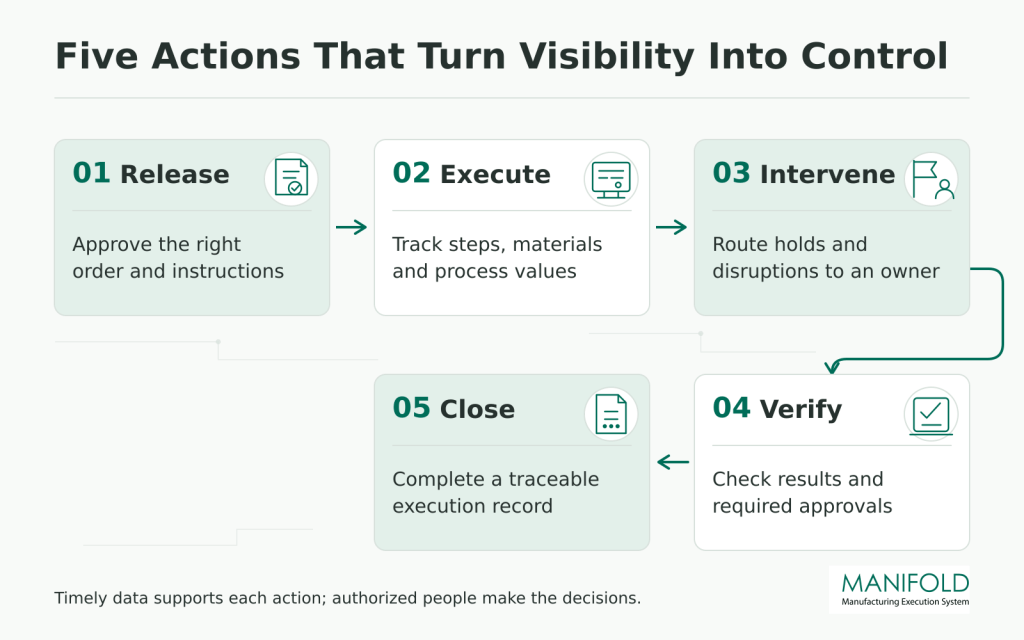
Release the right work order
Work order execution starts before an operator presses “start.” A planner may have scheduled the job, but the production team still needs a clear release decision: which order, revision, quantity, route, materials, equipment, and instructions apply? If a change arrives mid-shift, the team needs to know whether the original instruction remains valid and who can approve the replacement. A controlled release makes that responsibility explicit.
The release point also creates a meaningful baseline. Supervisors can compare expected and actual timing against the same order and stage instead of trying to reconcile several versions of the plan. In batch operations, this helps teams distinguish a late start from a slow process step; those are different problems and call for different responses.
Guide the process without removing judgment
A production workflow should present the next required step and capture the completion of the current one. It can identify an in-process check, show an approved instruction, and record a process value entered manually or received through an integration. The goal is to support the person performing the work, not to imply that every decision should be automated.
Good production process control accounts for real exceptions. Equipment may be unavailable, a measured value may require review, or the correct material may not be at the line. The workflow must offer a defined route for pause, hold, escalation, or restart, with permission appropriate to the risk. A rigid screen that leaves no valid exception path simply drives people back to paper.
Keep materials and equipment tied to the job
A status board may show an order as active without proving which materials were assigned or consumed. During production execution, the connection between order, material, equipment, and process stage matters. It supports reconciliation, makes a shortage visible while the job is underway, and gives reviewers a usable history afterward. The required level of detail should reflect the manufacturing process and its control requirements.
This is also why data context matters. NIST guidance on collecting and reusing manufacturing data addresses the need to manage data from shop floor equipment in a form that systems can use. A number with no order or equipment identity has limited value when a supervisor must decide what to hold or release.
Give exceptions an owner and a route
Suppose a quality result falls outside the defined limit during an active order. The alert alone does not specify the affected work, the person who must review it, or whether the next operation can start. The control procedure should identify the affected stage, assign the issue, preserve the original observation, and capture the decision. When a hold is required, only an authorized role should resume the work after the conditions for release are met.
A similar pattern applies to downtime. Record when it began and ended, capture a reason as close to the event as practical, and connect the event to the order and equipment. Then distinguish an operator correction from a maintenance intervention or a scheduling change. The response should match the cause; one generic “delay” status rarely gives the team enough to act on.
Assess Your Production Control.
Use the Production Control Maturity Assessment to score one real order across release, execution, exception ownership, quality checks, and closure. Start with a troublesome line or batch rather than averaging away the gaps across the whole plant.
Verify before closing
A batch marked 100% complete is not necessarily ready for review. The team may still need to confirm quantities, process values, material use, signatures, unresolved holds, and required quality results. A controlled closeout makes missing items visible while the people and evidence are still available. It also tells downstream teams what “complete” means for this process.
This is where electronic records earn their place. A useful record preserves the sequence of work, who performed or approved each relevant action, when it occurred, and what changed. It should make review easier without claiming that software itself guarantees compliance. Each organization still has to define procedures, permissions, validation, and record-retention rules that suit its obligations.
How Do Manufacturers Improve Production Execution?
Start with a single decision that regularly arrives too late. It might be whether to release an order, respond to a material shortage, investigate an unexpected stop, or clear an in-process check. Walk that decision backward: what event triggers it, which information must be current, who owns it, what actions are permitted, and what proves it was resolved? This yields a better control requirement than a broad request for “real-time dashboards.”
Then map the current route from plan to work order, from operator action to review, and from exception to resolution. Mark each handoff where people retype a status or chase approval. Keep the controls that genuinely reduce variation. Remove duplicate recording where a trusted source can provide the same fact. Pilot the revised route with the people who perform the work and test an abnormal case, not only the ideal run.
Finally, choose a small set of measures that reveal whether execution has improved: time from exception to assignment, time from assignment to response, orders closed with missing information, repeated hold reasons, or the share of downtime events recorded before shift end. These measures are examples, not universal benchmarks. Set baselines at your own site and review whether the new process changes the actual decisions.
How Can Manufacturers Control Production Processes In Real Time?
“Real time” should mean that the information arrives soon enough for the team to change the outcome, not that every sensor updates every second. A stoppage that threatens the current batch needs a quick, owned response. A trend for the weekly improvement meeting can tolerate a slower update. Define the decision window first, then specify capture frequency, notifications, escalation, and system integration around it.
The distinction matters when several applications share production information. NIST’s Knowledge Extraction and Application program discusses the difficulty of linking data from systems that were not designed to interact and relates that work to operations decisions, scheduling, and execution management. A plant should therefore test the path from an event to a decision across its actual systems, rather than assuming a new display resolves every handoff.
Where Manufacturing Execution Fits
As the number of orders, lines, materials, checks, and exceptions grows, spreadsheets and disconnected forms become harder to govern. Manufacturing execution software can provide the layer that relates planning information to production activity, guides authorized steps, records outcomes, and exposes current state. It does not replace operational rules. It puts those rules where work happens.
If you’re evaluating that layer, the next cluster article on MES software should compare process fit, integration, operator use, quality checkpoints, and traceability. Manifold MES includes planning, materials, in-process checks, electronic batch records, monitoring, and connections to Spectrum quality and laboratory systems. The specific workflow and integration scope should be confirmed during a product demonstration.
A concrete implementation example is AGP’s Manifold MES announcement, which describes the intended connection from planning through electronic batch manufacturing records and batch closure. That example shows a project direction; it does not establish a quantified result for every manufacturer. For a closer look at the control layer itself, see the article on manufacturing control systems and the shop floor.
Move One Decision From Observation To Closure
Choose an order that often needs human intervention. Can the team see its current state? Can they identify the right material, equipment, step, and owner? When something goes wrong, can they route a permitted action and document the decision? Can they verify what happened before marking the order complete? Those answers reveal the difference between a visible plant and a controlled one.
Production monitoring shows the condition. Production control gives people a dependable way to respond. When the two work together, teams spend less time reconstructing events and more time making the next sound decision.
Explore Manifold MES
See how Manifold connects work orders, materials, process checks, exceptions, and execution records in one production workflow.
Frequently Asked Questions
It is the coordinated release, execution, intervention, verification, and closure of production work. The controls and approvals depend on the product, process, and site.
Monitoring reports current or past conditions. Control defines who can act on those conditions, which steps they can take, and how they record and verify the result.
Common elements include order status, approved instructions, material and equipment use, process values, in-process checks, downtime reasons, holds, authorized interventions, and completion records.
A clear release and stage-by-stage record reduce ambiguity about the active job, the applicable instruction, and the next required action. Any improvement in time or output must be measured at the site.
They need information and escalation quickly enough to affect the active order. The required update speed should match the decision window and the risk of a late response.
