
 Sabeen Khalid
A batch finishes, but the review does not. A signature is missing. A material lot needs verification. A process value lacks context. Production ended hours ago, yet teams are still piecing together what happened.
This is a common challenge in paper-based manufacturing.
The issue is not only the record itself. The challenge is that production activities, materials, equipment information, and process data are often captured separately from the actual execution process.
This creates delays in review, limits real-time visibility, and makes it harder to understand the complete history of a batch.
That is where the difference between paper batch records and electronic batch records becomes significant.
However, electronic batch records alone do not execute manufacturing.
The MES executes the workflow and uses the eBMR as the digital record of that execution.
Why Paper Batch Records Create Execution Challenges
For decades, paper has been the standard method for documenting regulated manufacturing.
A batch manufacturing record provides approved instructions and captures evidence of how a batch was produced.
But paper records depend heavily on manual coordination.
Operators record activities after performing them. Supervisors verify completed steps. Quality teams review the record after production is finished.
This approach creates several operational challenges:
- Limited visibility during production
- Manual verification of activities
- Delayed identification of missing information
- Difficulty connecting materials, equipment, and operators to specific batch events
The record shows what happened, but it does not actively guide how work should happen.
Modern manufacturing requires a more connected approach.
MES Is the Foundation for Electronic Batch Execution
Electronic batch records deliver their greatest value when they are created through a Manufacturing Execution System.
An MES connects:
- Production orders
- Approved manufacturing instructions
- Materials
- Equipment
- Operators
- Process parameters
- Production activities
within one controlled execution environment.
The MES guides operators through defined workflows and captures execution data as activities occur.
The eBMR then becomes the complete digital history of the batch.
The relationship is simple:
Master Production Record defines the approved process.
MES controls and guides execution.
Electronic Batch Record captures the actual production history.
What Changes During Tablet Manufacturing With MES?
Consider tablet production:
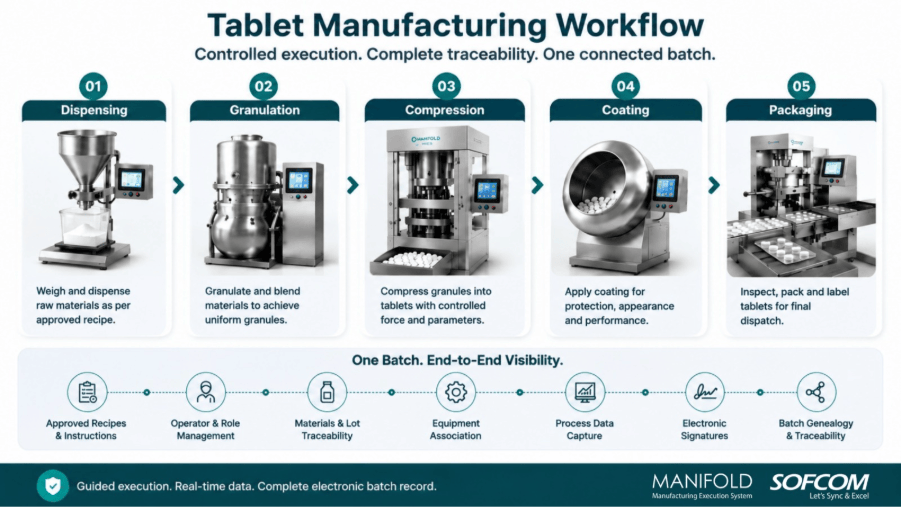
Each stage requires different materials, equipment, instructions, and process controls.
With paper-based execution, information from these activities may exist across multiple documents and logbooks.
With Manifold – Manufacturing Execution System, the entire workflow becomes connected.
Dispensing: Controlled Material Execution
Before dispensing begins, Manifold can ensure operators are working against the correct batch instructions.
The system connects:
- Required materials
- Material lots
- Quantities
- Operator identity
- Activity timestamps
This creates complete material traceability from the beginning of production.
Granulation: Recipe-Based Execution
Granulation requires specific process parameters and defined instructions.
Manifold enables recipe-driven execution by guiding operators through approved activities and capturing actual process values against the correct batch.
This ensures that production follows the defined manufacturing process.
Compression: Equipment and Process Visibility
During compression, equipment usage, process values, and operator activities become part of the electronic manufacturing history.
Teams can understand:
- Which equipment was used
- Who performed the activity
- What values were recorded
- When the activity occurred
Coating: Controlled Workflow Management
Coating involves multiple parameters and defined process steps.
Manifold maintains the connection between instructions, execution, and recorded values.
If an event requires attention, the activity can follow controlled workflows such as hold, review, and authorized continuation.
This helps reduce deviation risks by improving execution control and visibility.
Packaging: Complete Batch Genealogy
At packaging, the batch history continues with connected information from previous manufacturing stages.
Materials, equipment, operators, activities, and timestamps remain associated with the same batch.
The result is complete batch genealogy from dispensing to final packaging.
What Makes Manifold Different?
Many systems can digitize forms.
Manifold focuses on connecting manufacturing execution.
Manifold MES creates a controlled digital environment where people, processes, materials, equipment, and production data work together.
Its capabilities include:
Master Production Records
Approved manufacturing requirements are transformed into structured execution workflows.
Recipe Management
Manufacturing instructions and process parameters are controlled within the production workflow.
Role-Based Execution
Operators perform activities according to assigned responsibilities, creating accountability throughout production.
Electronic Signatures
Approvals and confirmations remain connected to the activity being performed.
Batch Genealogy
Materials, equipment, operators, process steps, and production events remain connected throughout the batch lifecycle.
This creates an electronic manufacturing history built during execution, not reconstructed afterward.
The Connected Plant Approach: MES, QMS, and LIMS Working Together
Manufacturing execution does not operate separately from quality and laboratory operations.
This is where Manifold’s connected plant vision becomes important. As pharmaceutical manufacturers move toward Pharma 4.0, the focus is shifting from isolated systems toward connected operations where manufacturing, quality, laboratory, and business processes work together.
This connected approach supports a broader connected plant strategy, where production data flows across manufacturing, quality, and laboratory operations instead of remaining isolated within separate systems.
Spectrum’s LIMS manages:
- Sample workflows
- Laboratory testing
- Results management
Spectrum’s QMS manages quality workflows including:
- Deviations
- Investigations
- CAPA
- Approvals
- Change controls
Together, these systems connect the complete product lifecycle:
Manufacturing execution → Quality evaluation → Laboratory testing → Decision making
Instead of disconnected records, teams gain a connected view of production and quality.
Move From Paper Records to Connected Batch Execution
Electronic batch records are not just a replacement for paper documentation.
They represent a shift toward controlled manufacturing execution, where production activities, resources, and data remain connected throughout the batch lifecycle.
With Manifold MES Software, manufacturers can create a digital execution environment that connects operators, materials, equipment, processes, and electronic batch records while providing the visibility needed to improve production control.
See how Manifold can help your organization move from manual batch documentation to connected electronic execution.
Business Impact of Electronic Batch Records
For manufacturing leaders, electronic batch records deliver value beyond eliminating paper.
They help organizations:
- Reduce manual review cycles
- Improve production visibility
- Strengthen traceability
- Improve data reliability
- Support faster decision-making
- Create stronger foundations for continuous improvement
The objective is not simply replacing paper forms.
The objective is creating a controlled manufacturing environment where production data is available, connected, and meaningful.
Frequently Asked Questions
They are digital records capturing production activities, materials, equipment, values, signatures, and timestamps during batch execution.
Paper mainly documents completed work. Digital records can guide execution and preserve production context while work occurs.
It can guide approved steps, capture actual values, connect resources, and maintain a structured batch history.
No. It provides more structured information, while quality oversight and authorized decisions remain essential.
It defines approved manufacturing instructions. The digital execution layer applies those instructions to each production batch.
