
 Mariya Abid
As pharmaceutical manufacturing continues to evolve, Pakistan’s industry stands at a defining moment. With increasing regulatory expectations, global competition, and the demand for operational excellence, digital transformation is no longer a future initiative—it’s a business imperative. This is where Pharma 4.0 comes into focus.
Pakistan’s Pharmaceutical Industry Is Entering a New Era
Pakistan’s pharmaceutical sector has developed into an industry valued at approximately $3.29 billion, according to the Trade Development Authority of Pakistan (TDAP). The sector supplies medicines to the domestic market while pursuing further opportunities in international markets. At the same time, manufacturers are navigating tighter regulatory scrutiny, higher customer expectations, and increasing pressure to improve quality, traceability, and production efficiency.
Traditional paper-based processes and disconnected systems often struggle to keep pace with these demands. Delayed documentation, manual quality checks, and siloed production data can slow operations and increase compliance risks.
Across the global pharmaceutical industry, these challenges are being addressed through Pharma 4.0—an industry transformation approach and operating model that applies Industry 4.0 capabilities to regulated pharmaceutical operations. The International Society for Pharmaceutical Engineering (ISPE) positions its Pharma 4.0 operating model as a pharma-specific interpretation of Industry 4.0, connecting digital technologies, organization and processes, resources, and information systems to support more agile and data-driven operations.
For Pakistan’s pharmaceutical industry, adopting Pharma 4.0 is more than keeping up with global trends. It’s about building a stronger foundation for sustainable growth, export readiness, and long-term competitiveness.
Curious how Pakistan’s pharmaceutical leaders are embracing digital transformation? Explore the insights shared during Spectrum for Life, where industry experts discussed the future of Pharma 4.0 and connected manufacturing. Watch Full Event Video on our YouTube Channel: Spectrum for Life – Pakistan 2026. Pharma 4.0: The Digital Shift for Better Lives
What Is Pharma 4.0?
Pharma 4.0 is the pharmaceutical industry’s adaptation of the broader Industry 4.0 movement. Introduced by the International Society for Pharmaceutical Engineering (ISPE), it promotes the integration of digital technologies, automation, and intelligent quality systems across the pharmaceutical value chain.
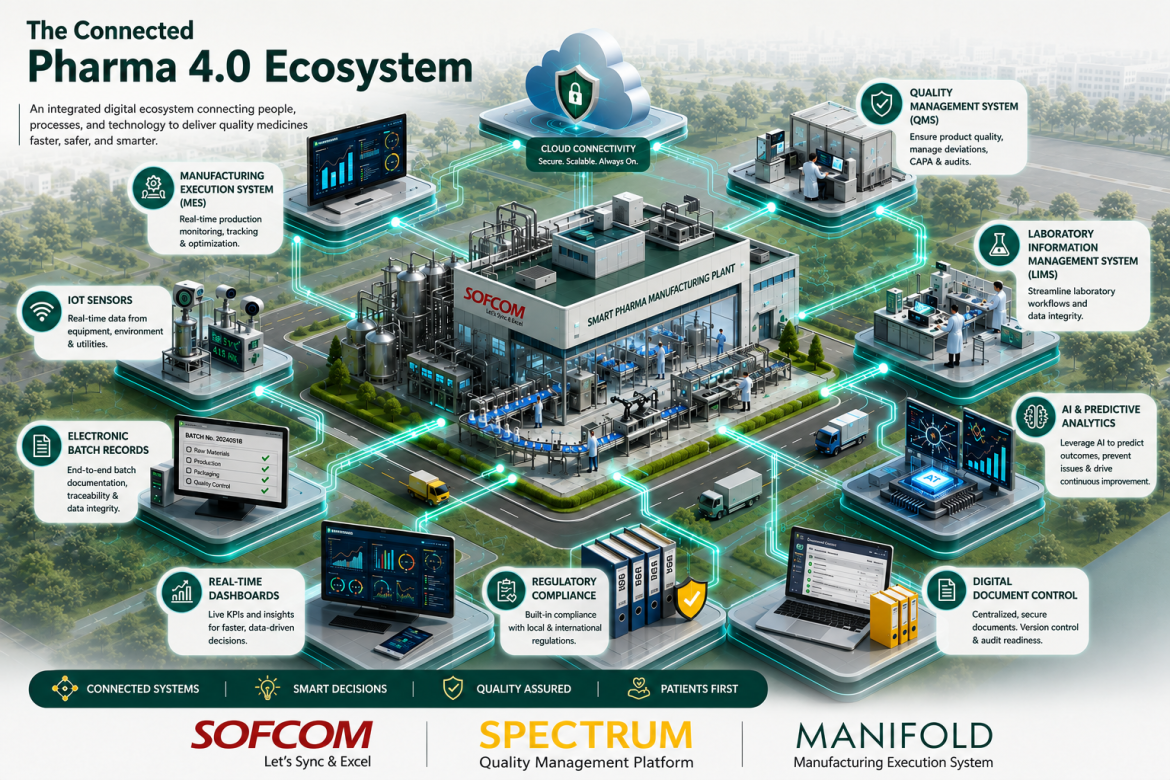
Rather than treating manufacturing, quality assurance, laboratories, and compliance as separate functions, Pharma 4.0 connects them through a unified digital ecosystem.
The result is faster decision-making, improved data integrity, greater process visibility, and stronger regulatory compliance.
Instead of reacting to issues after they occur, manufacturers gain the ability to predict risks, monitor production in real time, and continuously improve operations using reliable data.
Evolution of Pharmaceutical Manufacturing

Why Pharma 4.0 Matters for Pakistan
Pakistan’s pharmaceutical industry is evolving as companies modernize production facilities, strengthen quality systems, and work toward requirements relevant to their target markets. Depending on the organization and export destination, these may include WHO prequalification, ISO standards, PIC/S-aligned GMP expectations, or specific importing-market requirements.
However, digital transformation remains uneven.
Some manufacturers still rely on manual documentation, fragmented workflows, or disconnected software applications that limit operational visibility.
Pharma 4.0 helps bridge these gaps by enabling organizations to:
- Strengthen GMP compliance by improving the control, availability, and traceability of digital documentation.
- Protect data integrity by connecting manufacturing, laboratory, and quality records.
- Reduce preventable manual errors and time spent on repetitive administrative work.
- Support faster batch review and release through more accessible production and quality information.
- Improve deviation management by giving teams timely access to relevant process data.
- Enable better collaboration among production, QA, QC, laboratory, and regulatory teams.
- Improve audit readiness through centralized records, controlled access, and traceable activities.
For organizations aiming to align with international quality expectations, these capabilities are becoming increasingly important.
The Technologies Powering Pharma 4.0
Pharma 4.0 is not defined by a single software platform. It is an ecosystem of connected technologies, governed processes, and skilled people working together to improve pharmaceutical manufacturing.
Artificial Intelligence (AI)
AI can support anomaly detection, process monitoring, predictive quality, equipment reliability, and the identification of recurring production patterns. In regulated pharmaceutical manufacturing, however, effective use depends on fit-for-purpose and validated data, appropriate governance, documented controls, lifecycle management, and human oversight. The FDA has identified AI as a potential enabler of advanced manufacturing while emphasizing risk-based assessment and reliable model inputs.
Internet of Things (IoT)
Connected equipment and sensors provide real-time visibility into manufacturing environments, enabling proactive monitoring and improved operational control.
Cloud Computing
Cloud-based platforms can enable authorized access to quality documentation, production data, and compliance records across departments and manufacturing sites. In regulated environments, adoption requires appropriate security controls, role-based access, data governance, system validation, backup and recovery arrangements, vendor oversight, and clear responsibility for regulated records.
Advanced Analytics
Real-time dashboards transform operational data into actionable insights, helping leadership make faster and more informed decisions.
Connected Quality Systems
Modern pharmaceutical organizations can replace isolated applications with integrated digital platforms that connect Quality Management Systems (QMS), Laboratory Information Management Systems (LIMS), and Manufacturing Execution Systems (MES).
Building Connected Manufacturing with Digital Quality
Technology alone doesn’t create Pharma 4.0.
The real transformation happens when quality becomes integrated into every stage of manufacturing.
Digital Quality Management enables organizations to centralize document control, CAPA, deviations, audits, change control, training, and risk management within a connected environment.
When quality systems are connected with manufacturing and laboratory systems, authorized teams can access relevant data more efficiently—improving visibility across the operation and supporting better-informed decisions.
Sofcom’s Manifold MES and Spectrum Quality Management Platform support this connected approach by bringing manufacturing execution, quality workflows, laboratory processes, compliance records, and operational visibility into a more integrated digital ecosystem for regulated industries.
Discover how the Manifold Manufacturing Execution System (MES) helps pharmaceutical manufacturers digitize production workflows while improving visibility, traceability, and operational efficiency.
Pakistan’s Roadmap to Pharma 4.0
Digital transformation doesn’t happen overnight.
Successful organizations often begin with foundational improvements before expanding into advanced manufacturing technologies.
A practical roadmap may include:
- Digitizing controlled quality documentation to improve access, traceability, and audit readiness.
- Standardizing manufacturing workflows to reduce process variation and execution gaps.
- Integrating quality, laboratory, and production systems to create connected records and shared visibility.
- Introducing real-time operational dashboards based on reliable and contextualized data.
- Applying governed analytics to identify trends and continuously improve quality and performance.
This phased approach allows pharmaceutical companies to modernize operations while minimizing disruption.
Are You Ready for Pharma 4.0?
Ask yourself:
- Are quality records still largely paper-based?
- Can production, QA, QC, and leadership access the same information in real time?
- Is audit preparation still manual and time-consuming?
- Are deviations and CAPAs tracked through disconnected files or spreadsheets?
- Can laboratory results be linked easily to batch and quality records?
- Can leadership monitor manufacturing performance through live dashboards?
- Are quality decisions driven by reliable operational data?
If several of these questions highlight existing gaps, your organization may benefit from developing a structured Pharma 4.0 roadmap.
Moving from Digital Ambition to Digital Execution
Pharma 4.0 represents more than technological advancement. It reflects a new way of thinking about pharmaceutical manufacturing—where quality, compliance, production, and data work together as one connected ecosystem.
For Pakistan’s pharmaceutical industry, embracing this transformation presents an opportunity to improve operational excellence, strengthen regulatory compliance, and compete more effectively in international markets.
As the industry continues to evolve, organizations that invest in connected manufacturing today will be better positioned to meet tomorrow’s regulatory and business challenges.
Future-Proof Your Pharmaceutical Operations
Discover how Manifold and Spectrum help pharmaceutical manufacturers streamline production, improve quality, and accelerate their Pharma 4.0 journey through connected digital manufacturing.
Frequently Asked Questions
Pharma 4.0 is a pharmaceutical industry transformation approach that connects digital technologies, automation, people, processes, data analytics, and intelligent quality systems to improve regulated manufacturing operations.
Industry 4.0 applies to manufacturing in general, while Pharma 4.0 adapts these principles to meet the strict regulatory, quality, and compliance requirements of pharmaceutical production.
It helps manufacturers improve compliance, strengthen data integrity, enhance operational efficiency, and compete more effectively in global pharmaceutical markets.
Artificial Intelligence (AI), Internet of Things (IoT), cloud computing, advanced analytics, automation, Manufacturing Execution Systems (MES), Laboratory Information Management Systems (LIMS), and digital Quality Management Systems (QMS).
Most organizations begin by digitizing quality processes and integrating quality, laboratory, and manufacturing operations before expanding into advanced automation and predictive analytics.
