
 Sabeen Khalid
A manufacturing team replaces an equipment component. QC updates the testing method. Procurement proposes a different raw material supplier.
Each decision may solve an immediate problem. It can also affect product quality, validation, approved documents, employee training, or regulatory commitments.
Change control helps organizations evaluate the consequences before introducing a change and verifying the outcome afterward.
For pharmaceutical manufacturers, getting a request signed is only part of the work. The right people must assess the proposal, implementation activities must follow an approved sequence, and evidence must support closure.
This guide explains what change control means, how the process works, who participates, and when a digital system becomes useful.
What Is Change Control?
Change control is a documented process for assessing, authorizing, implementing, and reviewing changes that could affect product quality, validated state, regulatory commitments, or controlled operations.
It establishes what will change, why it is necessary, what could be affected, and what evidence is needed to demonstrate an acceptable outcome.
EU GMP Annex 15 describes a formal system involving qualified representatives from relevant disciplines to assess changes that may affect the validated status of facilities, systems, equipment, or processes.
A useful change record answers six questions:
- What is the current approved arrangement?
- What is being proposed, and why?
- Which products, processes, documents, or systems could be affected?
- Who must assess and authorize the proposal?
- What must happen before the changed arrangement is used?
- How will the organization confirm that the change worked?
These questions turn an approval form into a practical quality decision.
Why Change Control Matters
Consider replacing a filling machine with a higher-capacity model. Engineering may confirm installation, while other requirements remain unresolved: qualification, cleaning instructions, operator training, and batch record revisions.
If those gaps emerge when production is ready to start, the business may face rescheduling, additional review, and downtime. Change control identifies dependencies before they disrupt operations.
There is also a regulatory foundation. For drug products subject to US CGMP requirements, 21 CFR 211.100 requires written production and process control procedures, including changes, to receive appropriate organizational review and quality control unit approval.
ICH Q10: Pharmaceutical Quality System recommends risk-based evaluation, relevant expert input, regulatory assessment, and post-implementation review. It provides a quality-system model used alongside applicable regional requirements.
The business value comes from introducing improvements without losing control of quality, readiness, or the supporting records.
Which Changes Require Assessment?
Ask whether the modification could affect quality, reproducibility, approved requirements, or validated operations.
EU GMP Annex 15 identifies materials, product components, processes, equipment, premises, production or testing methods, and batch size among the areas requiring planned change assessment where quality or reproducibility may be affected.
| Change area | Example | Assessment considerations |
|---|---|---|
| Materials and suppliers | Alternative excipient supplier | Material characteristics, supplier qualification, testing |
| Manufacturing | Revised drying cycle | Product performance, process consistency, validation |
| Equipment | Replacement product-contact component | Compatibility, cleaning, qualification |
| Laboratory methods | Revised analytical procedure | Method validation or verification, training, specifications |
| Facilities and utilities | Modified HVAC arrangement | Environmental conditions, contamination controls |
| Packaging | Different container closure | Compatibility, stability, regulatory implications |
| Computerized systems | Updated LIMS calculation | Calculation accuracy, data integrity, validated functionality |
| Controlled documents | Revised production instruction | Changes to practice, responsibilities, acceptance criteria |
These examples focus on pharmaceutical manufacturing. Other industries should assess changes against their own applicable regulations, standards, and product-specific risks.
Not every change requires full revalidation. A documented impact assessment should determine the verification, qualification, or validation activities needed—even when a change is classified as minor. A spelling correction and a revised sterilization parameter have different consequences, so the required work should reflect the assessed impact.
Internal classifications such as “minor” and “major” need documented criteria. They are distinct from regulatory reporting categories, which can differ by market.
Change Control Procedure: 7 Steps From Initiation to Closure
A change control procedure defines responsibilities, review requirements, implementation conditions, and closure evidence. Organizations can adapt the following lifecycle to their approved quality system.
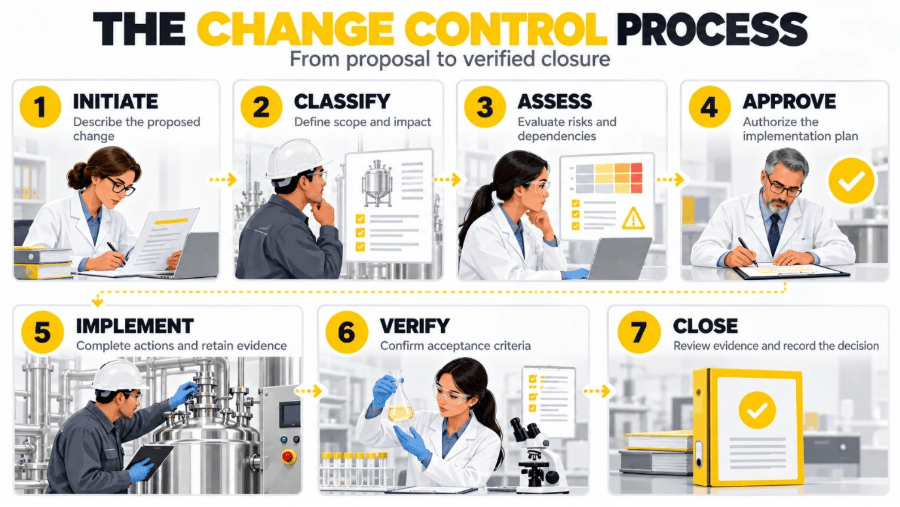
1. Initiate the request
Describe the current and proposed states clearly.
“Improve equipment” is insufficient. “Replace mixer M-04 with mixer M-09 for Product X” gives reviewers a defined proposal.
Record the reason, initiator, affected area, proposed timing, and related records, such as an investigation, CAPA, or supplier notification.
2. Define scope and classify the change
Identify affected products, sites, equipment, methods, documents, and systems.
A revised specification may affect laboratory configuration, supplier documentation, and reporting templates. Scope assessment should capture these dependencies.
Assign a coordinator and select the review route using approved classification criteria.
3. Assess impact and risk
Relevant specialists evaluate their areas of responsibility. They identify potential consequences, necessary controls, and evidence needed to demonstrate an acceptable result.
ICH Q10 recommends matching the formality of evaluation to risk, considering regulatory implications, involving appropriate expertise, and defining evaluation criteria before implementation.
For equipment changes, assess cleaning, operating ranges, qualification, maintenance, documents, training, and regulatory commitments as applicable.
4. Approve the implementation plan
Convert the assessment into specific actions with owners, deadlines, dependencies, and acceptance criteria.
Identify activities required before installation or operational use. Include regulatory authorization where necessary.
Approval of the proposal does not automatically mean the changed process is ready for use.
5. Implement and retain evidence
Execute the authorized plan and record what happened at the time of performance
Evidence may include installation records, test results, document revisions, training completion, and implementation dates.
Material departures from the approved scope should receive appropriate reassessment before the team proceeds.
6. Verify the outcome
Confirm that required activities are complete and acceptance criteria are met.
Where appropriate, monitor performance after implementation. A packaging change, for example, may require reviewing seal integrity or rejection trends over a justified period.
ICH Q10 recommends checking whether the change achieved its objectives without harmful effects on product quality.
7. Review and close
The authorized reviewer confirms that evidence supports closure.
Remaining monitoring commitments need defined ownership and tracking consistent with the procedure. Rejected or cancelled requests should also retain their decision history.
Who Is Involved?
QA provides oversight, while technical assessment depends on the people who understand the affected operation.
The allocation below is illustrative. Formal authority should follow approved procedures.
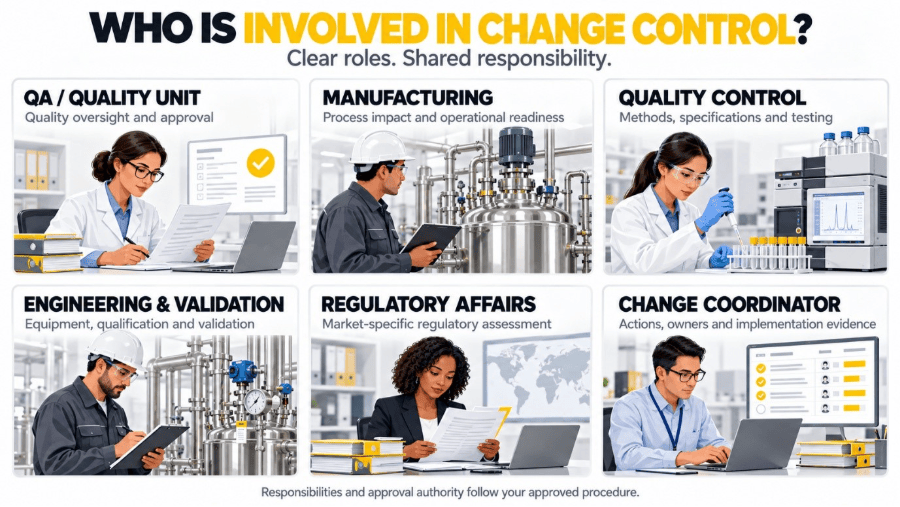
An assigned owner needs a clear deliverable. “Update documents” is weaker than identifying the affected SOPs, responsible person, and completion requirements.
What Should a Change Control Template Include?
A change control template should typically capture:
- Change description
- Reason and justification
- Current and proposed state
- Scope and affected areas
- Risk assessment
- Regulatory impact
- Required actions
- Owners and due dates
- Approval requirements
- Implementation evidence
- Verification criteria
- Closure decision
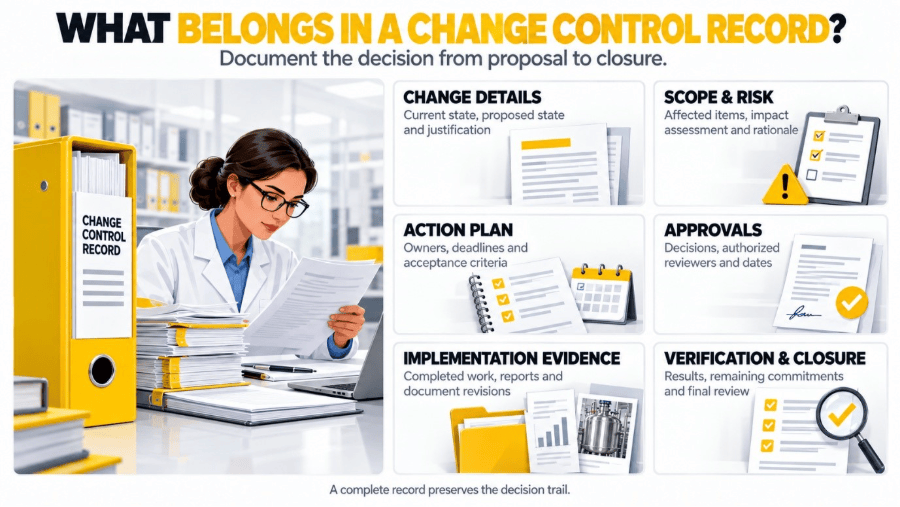
Supporting records may include risk assessments, protocols, reports, revised specifications, SOPs, training evidence, and regulatory correspondence.
Retention periods should follow applicable requirements and the approved retention schedule. There is no single period suitable for every change-related record.
How Change Control Connects With CAPA and Document Control
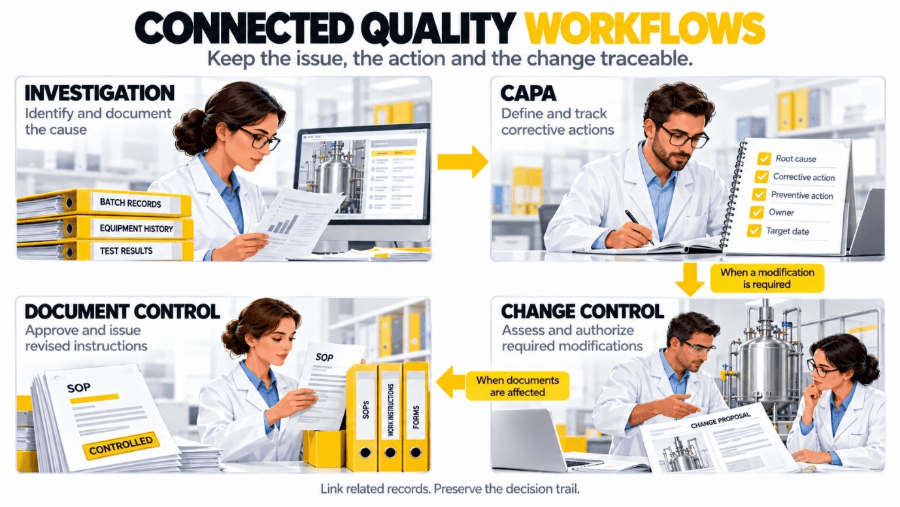
These processes interact but have different purposes.
CAPA addresses the causes of quality problems or prevents their occurrence. Change control governs modifications arising from those actions. Document control manages the resulting revisions, approvals, and availability of controlled documents.
For example, an investigation identifies an unsuitable equipment setting. CAPA defines corrective action, change control assesses the proposed modification, and document control manages revised instructions.
Not every CAPA requires change control. Not every document revision needs an extensive assessment. Approved procedures should define when the processes connect.
Where Organizations Commonly Struggle
Gaps often appear between departments and stages:
- Incomplete scope: An equipment assessment overlooks the affected laboratory method.
- Unclear ownership: Actions remain open because responsibility is shared but undefined.
- Disconnected evidence: Assessments sit in email, tasks in spreadsheets, and reports in folders.
- Premature closure: Installation is treated as completion while verification remains outstanding.
- Uncontrolled temporary changes: A temporary arrangement continues without an expiry or review.
These weaknesses can create avoidable rework and readiness delays. An urgent change also needs an authorized route with defined controls.
Sofcom’s article on spreadsheet-based CAPA, deviation, and change control explores related challenges caused by fragmented quality records.
How to Measure Performance
Change Control KPIs
Track where changes wait and whether implementation achieves the intended outcome. Use these KPIs to identify delays, incomplete assessments, and issues requiring follow-up.
| KPI | What to track |
|---|---|
| Average assessment time | Time taken to complete impact assessments |
| Average approval time | Time from submission for approval to the approval decision |
| Overdue actions | Actions past their agreed due dates |
| Changes awaiting verification | Implemented changes with required verification outstanding |
| Changes returned for incomplete assessment | Requests returned because assessments lack information or evidence |
| Average closure time | Time from change initiation to authorized closure |
| Percentage closed by target date | Proportion of changes closed within agreed timelines |
| Recurring changes by category | Repeated changes affecting similar processes, equipment, or documents |
| Post-implementation issues | Quality issues potentially associated with implemented changes |
Define consistent measurement points and review results by change category and risk. Investigate the reasons behind delays. Missing ownership, unavailable validation resources, and pending regulatory decisions require different responses.
Review timeliness alongside verification and outcome data. Faster closure alone does not demonstrate effective change control.
When a Digital Change Control System Becomes Useful
A change control system includes people, procedures, responsibilities, and records. Software becomes useful when maintaining their relationships grows difficult.
Warning signs include repeated status chasing, uncertain approval history, overdue tasks, and difficulty retrieving complete evidence.
Spectrum’s change control module brings assessments, approvals, actions, implementation evidence, and closure into a connected workflow. Category-based workflows, assigned actions and due dates, notifications, electronic signatures, implementation records, and links to investigations and CAPA help teams maintain a traceable record from the initial request through final closure.
Effective use still requires appropriate configuration, training, controlled procedures, and validation where applicable.
Explore Spectrum Change Control to see how assessments, approvals, and implementation activities can follow a controlled workflow.
Make Every Change Traceable
Effective change control connects proposals with the people, records, and evidence needed to implement them responsibly.
If your team spends more time locating approvals than evaluating changes, examine how information moves through your quality system.
Discuss your change control procedures with our team and explore connected assessment, approval, task tracking, and implementation records.
Frequently Asked Questions
The terms overlap. Change control commonly governs individual changes, while change management can include broader oversight of the process and change portfolio.
The approved procedure should determine this. Editorial corrections may follow document control alone; revisions that alter operations may require broader assessment.
Approval authorizes a defined proposal or activity. Closure records the final conclusion after reviewing required implementation and verification of evidence.
