
 Rabeeka Siddiqui
Payroll is one of those business functions that has to be right every time. Employees expect accurate pay, finance teams need reliable numbers, and HR needs enough time to focus on people rather than chasing payroll changes.
As an organization grows, payroll rarely stays simple. More employees can mean more compensation structures, benefits, deductions, locations, approvals, reporting requirements, and records. A process that worked for a smaller workforce can become a recurring administrative burden.
Businesses often reach a point where managing payroll entirely in-house starts to become difficult. As the workforce grows, payroll can require more time, specialist knowledge, and coordination than an internal team can comfortably handle.
That is when many businesses begin considering payroll outsourcing. The question is not simply whether outsourcing can save time. It is whether working with a specialist can provide a more consistent, reliable payroll process while giving the internal team more capacity to focus on other priorities.
1. Reduce the Administrative Load on HR
Payroll can consume a significant amount of HR time. Each cycle may involve collecting employee changes, checking inputs, reviewing compensation updates, coordinating approvals, answering questions, and resolving exceptions.
As headcount grows, these tasks multiply. Payroll outsourcing can move much of this recurring administration to a specialist provider while keeping HR involved in the approvals, reporting, and decisions that matter.
2. Bring Specialist Payroll Expertise Into the Business
Payroll has its own technical requirements. Employers may need to manage federal employment taxes, withholding, deposits, reporting, recordkeeping, and applicable state or local requirements.
The IRS explains that employers generally have responsibilities for withholding, depositing, reporting, and paying applicable employment taxes. Its 2026 Employer’s Tax Guide covers federal income tax, Social Security, Medicare, and FUTA requirements.
A dedicated payroll provider can bring specialized processes, experienced personnel, and defined controls to these recurring requirements. This can be particularly valuable when payroll knowledge is concentrated in only one or two internal employees.
3. Improve Payroll Consistency
A reliable payroll operation depends on repeatable steps. Information needs to be collected, checked, approved, processed, reported, and stored consistently.
When payroll depends on spreadsheets, email chains, or manual handoffs, the process can vary depending on who is managing it. A structured payroll outsourcing process can establish clearer responsibilities and repeatable controls.
4. Strengthen Payroll Compliance
Payroll compliance is an ongoing responsibility. Employers need to keep up with tax requirements, filing schedules, recordkeeping, and changes that affect payroll.
The IRS says employment tax records generally must be kept for at least four years and should include items such as wage payments, employee information, withholding certificates, tax deposits, and filed returns.
Outsourcing does not remove the employer’s responsibilities. Instead, the value of a good provider is the structure and expertise it brings to the process.
5. Reduce Dependency on Internal Payroll Resources
Payroll knowledge can become concentrated in a small number of employees. If the person who understands the process is away or leaves the company, the business can suddenly have a knowledge gap.
Payroll outsourcing can reduce that dependency by placing recurring activities within a dedicated service structure. Documentation, workflows, reports, and defined responsibilities make the process less dependent on individual memory.
6. Support Growth Without Adding Payroll Complexity
Growth changes payroll. New employees, additional locations, new benefits, revised compensation plans, and changing workforce structures all add administration.
A payroll model that works for a small workforce may not work as well at a larger scale. Outsourcing can provide access to a payroll operation designed to handle higher volumes and more complex requirements.
7. Give HR More Room for Strategic Work
Perhaps the most important reason to outsource payroll is opportunity cost. Every hour HR spends resolving payroll exceptions, preparing reports, following up on approvals, or answering routine questions is time that cannot be spent on workforce planning, employee experience, development, or engagement.
Payroll outsourcing can help shift that balance. The objective is not to make payroll invisible. It is to make payroll easier to manage so HR can spend more attention where it creates greater value.
What Does the Payroll Outsourcing Process Look Like?
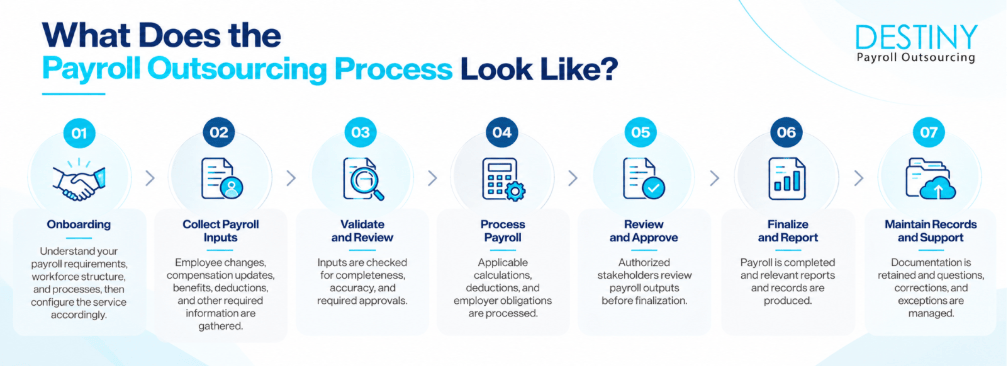
A professional payroll outsourcing process should be clear enough that the business understands what happens at every stage. A typical model can look like this:
- Collect payroll inputs: employee changes, compensation updates, benefits, deductions, and other required information are gathered.
- Validate and review: inputs are checked for completeness, accuracy, and required approvals.
- Process payroll: applicable calculations, deductions, and employer obligations are processed.
- Review and approve: authorized stakeholders review payroll outputs before finalization.
- Finalize and report: payroll is completed and relevant reports and records are produced.
- Maintain records and support: documentation is retained and questions, corrections, and exceptions are managed.
The value of outsourcing comes from having this process managed consistently, with clear ownership between the business and provider.
When Does It Make Sense to Outsource Payroll?
There is no single employee count at which every business should outsource. The better question is whether the current model is creating more complexity than the organization wants to manage internally.
Payroll outsourcing may be worth considering when HR is spending significant time on payroll administration, payroll has become difficult to manage across locations, internal expertise is limited, reporting is inconsistent, or the business is scaling faster than its payroll processes.
What Should Businesses Look for in Payroll Outsourcing?
Not all providers offer the same level of service. Look beyond the promise of saving time and ask how the provider actually manages payroll.
| Question to Ask | Why It Matters |
|---|---|
| How are payroll inputs collected and verified? | Shows how information is controlled before processing. |
| Who approves payroll before finalization? | Clarifies accountability and internal controls. |
| What reports and records will we receive? | Shows how much visibility the business retains. |
| How are corrections handled? | Reveals how exceptions are documented and resolved. |
| How does the provider support changing requirements? | Helps assess long-term suitability as the business grows. |
| How is employee payroll data protected? | Payroll contains sensitive personal and financial information. |
Why Outsource Your Payroll to Destiny?
Destiny is built for organizations that want payroll managed as a dependable business function, not simply as a monthly administrative task.
As a premium payroll outsourcing service, Destiny brings structured payroll management, reporting, documentation, and operational support together. The focus is on giving HR and finance teams a reliable payroll partner while maintaining the visibility and control they need.
For businesses asking why outsource payroll, the stronger question is what they want their payroll operation to look like after outsourcing. Destiny is designed to provide a more organized, consistent, and scalable way to manage that responsibility.
Payroll Outsourcing vs. Keeping Payroll In-House
Keeping payroll in-house can work well when the business has the people, systems, and time to manage it effectively. The challenge comes when the payroll function grows faster than the internal operating model. HR may still be expected to manage payroll while also supporting recruitment, employee relations, workforce planning, benefits, and other priorities.
A useful way to make the decision is to compare the full workload rather than the payroll salary line alone. Internal payroll has direct costs, but it also requires software, training, process ownership, backup coverage, compliance monitoring, reporting, and time spent resolving exceptions.
Internal vs. Outsourced Payroll: Internal payroll keeps day-to-day control inside the organization but requires ongoing payroll capacity, backup coverage, and specialist knowledge. Outsourcing moves defined operational work to a provider while the business retains appropriate oversight and approvals.
For some organizations, outsourcing creates a better balance: internal leaders retain oversight while a specialist team manages the recurring operational work.
The Business Case Is About More Than Cost
Cost to outsource payroll is naturally part of the decision, but it should not be the only measure. A payroll provider should be evaluated on the value of the operating model it creates.
Consider the cost of repeated manual work, delayed approvals, payroll corrections, employee questions, and the risk of losing critical payroll knowledge. A service that reduces those pressures can have value even when its monthly fee is higher than a basic software subscription.
The strongest business case is therefore not “outsourcing is cheaper.” It is “outsourcing gives the business a more dependable way to manage an important function.”
Conclusion
Payroll is too important to be treated as an afterthought, but it also does not have to consume your internal team’s time. For growing businesses, payroll outsourcing can provide specialist support, more consistent processes, stronger documentation, and a model that scales with the workforce. The right decision is not simply whether to outsource. It is whether the provider can give your business a dependable payroll operation while preserving the visibility and control you need.
Give your team less payroll administration and more room for strategic work.
FAQs
No. Businesses of different sizes can outsource payroll. The decision should be based on payroll complexity, internal resources, locations, compliance needs, and the amount of administration the business wants to retain.
Benefits can include reduced administrative workload, access to payroll expertise, more consistent processes, stronger documentation, easier scaling, and more time for HR to focus on strategic priorities.
It should not. A well-structured arrangement defines responsibilities, approvals, reporting, access, and correction procedures so the business maintains appropriate oversight.
A specialist provider can bring structured processes and payroll expertise to calculations, reporting, documentation, and tax administration. Employers should still understand their own responsibilities.
Consider outsourcing when payroll administration is consuming significant HR time, internal expertise is limited, payroll is becoming more complex, or the organization needs a more scalable operating model.
Ask about process controls, reporting, documentation, security, correction procedures, responsibilities, support, scalability, and how the provider handles changes in your workforce.
