
 Sofcom Inc.
Flexibility Is Bigger Than Remote Work
Employee expectations have evolved, but workplace flexibility should not be reduced to a debate about working from home. For an office employee, flexibility may mean hybrid work or adjustable start times. For a plant, retail, healthcare, logistics, or field employee, it may mean predictable shifts, easier leave requests, mobile access to HR services, or greater input into scheduling.
The strongest flexibility strategies recognize these differences. They balance employee needs with customer service, safety, staffing, collaboration, and legal obligations. Policy defines what is allowed; managers apply it fairly; and HCM software helps turn the policy into consistent schedules, requests, approvals, records, and workforce insight.
The Evolution of Work and Flexibility
Flexible work existed long before large-scale remote work. It includes changes to hours, start and finish times, days worked, shifts, workload, leave arrangements, and work location. The International Labor Organization notes that working-time arrangements can support work-life balance and productivity when they are designed with both worker and organizational needs in mind.
That broader definition matters because flexibility is not equally available across roles. A laboratory analyst, machine operator, salesperson, and finance professional face different operational constraints. Employers should therefore avoid a single model and instead establish role-based options, transparent eligibility criteria, reliable coverage, and a clear process for requests and exceptions.
Common forms of flexibility include:
- Flexible start and finish times or staggered schedules
- Hybrid or remote work where the role allows it
- Compressed workweeks, part-time work, or job sharing where operationally viable
- Predictable shifts, shift swaps, and employee scheduling preferences
- Structured leave, caregiving support, phased returns, and reasonable accommodations
- Mobile access to HR information and requests for frontline, field, and distributed employees
Why Workplace Flexibility Matters
Work-Life Balance and Well-Being
Employee-oriented flexibility can give people more control over how work fits with health, family, education, commuting, and other responsibilities. OECD research associates flexible hours and telework with positive well-being effects, while also warning that poorly managed flexibility can increase work intensity, unpaid overtime, and work-life conflict. Flexibility therefore needs workload boundaries, realistic staffing, and manager support—not simply permission to work anywhere.
Talent Attraction, Inclusion, and Retention
Flexible arrangements can widen access to work for caregivers, people with disabilities, older workers, parents returning to work, and employees who live farther from major offices. OECD analysis identifies flexibility as an important working condition that can support retention and worker well-being. The opportunity is strongest when flexibility is offered fairly and does not quietly limit development, visibility, or advancement.
Continuity and Workforce Resilience
A workforce that can adjust schedules, locations, and capacity is better prepared for disruption, seasonal demand, personal emergencies, and changing business needs. This does not mean every request can be approved. It means the organization has defined options, current workforce data, backup coverage, and workflows that help managers make timely, consistent decisions.
How HCM Software Enables Flexible Work
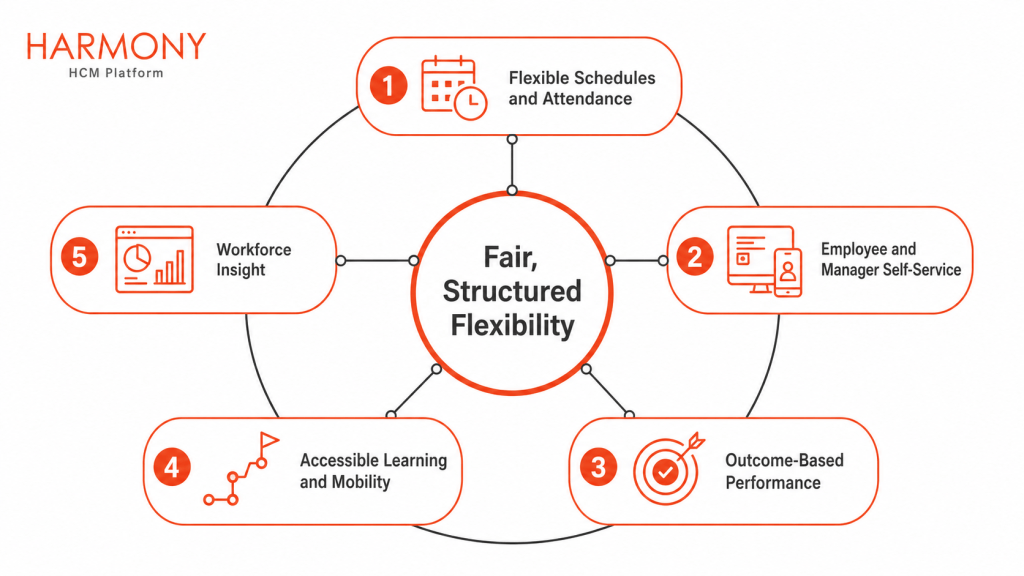
Modern HCM software does not create a flexible culture by itself. It provides the operational foundation for applying flexibility at scale: one employee record, role and location structures, schedules, attendance, leave, approvals, communication, performance, learning, and reporting.
1. Flexible Scheduling and Time Management
Time and attendance tools can support shifts, rosters, attendance capture, exceptions, overtime rules, leave, and manager approvals. With better visibility, managers can assess coverage before approving a schedule change and employees can see the status of their requests. Rules should reflect applicable law, contracts, policies, and the realities of each role.
2. Employee and Manager Self-Service
Self-service gives employees a consistent way to view records, check leave balances, access pay information, submit requests, and follow approvals without relying on informal messages. Mobile access is especially important for employees who do not work at a desk. Harmony’s Employee Self-Service Portal supports leave applications, attendance exceptions, personal-data updates, payslips, balances, and other employee workflows through web and mobile access.
3. Performance Based on Outcomes and Clear Goals
Flexible work can fail when visibility is mistaken for performance. A structured performance process helps managers set objectives, document expectations, give feedback, and review progress consistently across locations and schedules. Harmony’s performance management tools support goal setting, progress tracking, reviews, and appraisal workflows. The quality of performance management still depends on relevant goals, regular conversations, and trained managers.
4. Learning and Internal Mobility
A flexible workplace should also make development accessible. Centralized learning records, training assignments, feedback, and internal opportunities can help employees build skills regardless of location or schedule. Organizations should monitor whether shift patterns, part-time arrangements, or remote status create unequal access to training and advancement.
5. Workforce Data for Fairer Decisions
HCM reporting can help HR compare requests, approvals, attendance patterns, turnover, development, and performance across teams and employee groups. The purpose is to identify operational issues and inconsistent application—not to introduce intrusive surveillance. Access should be role-based, definitions should be consistent, and sensitive results should be interpreted in context.
Turn flexible-work policies into consistent employee experiences with connected attendance, leave, self-service, performance, learning, and workforce workflows. Explore Harmony HCM.
Overcoming the Challenges of Flexibility
Flexibility works best when organizations address the trade-offs directly:
- Fairness across roles. Offer meaningful forms of flexibility to employees who cannot work remotely, such as predictable shifts, easier swaps, mobile self-service, or schedule input.
- Autonomy and accountability. Define availability, service levels, handoffs, goals, and escalation routes without measuring productivity through constant digital presence.
- Workload and boundaries. Monitor excessive hours, understaffing, meeting overload, and expectations to remain available outside agreed working time.
- Manager consistency. Train managers to assess requests against documented criteria and record reasons for decisions rather than relying on personal preference.
- Data protection and trust. Collect only necessary data, restrict access, and avoid using attendance or location information as an automatic proxy for performance.
- Team connection. Design deliberate communication, onboarding, learning, and collaboration practices so employees are not disadvantaged by schedule or location.
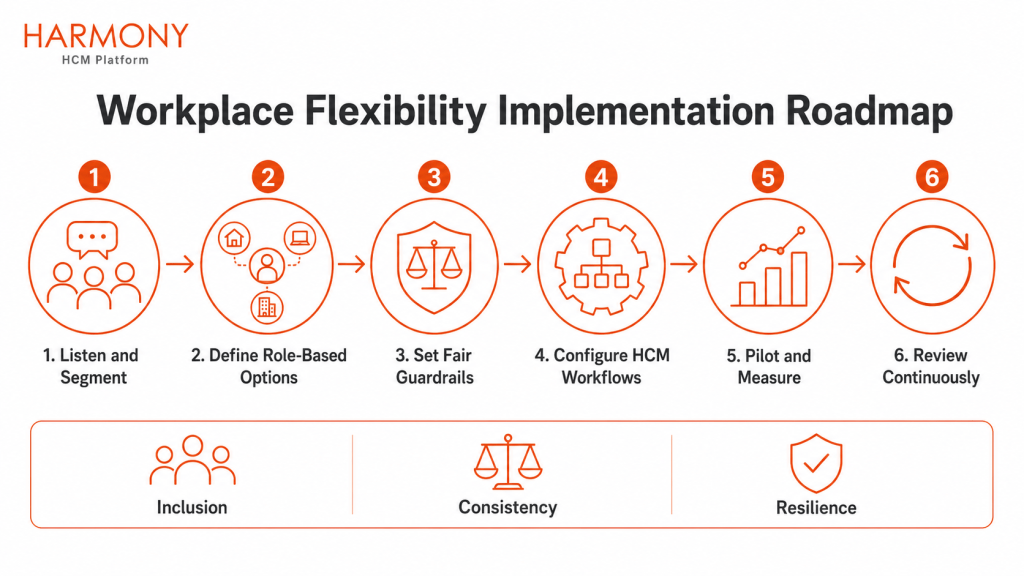
Building a Flexible Workplace: A Six-Step Approach
- Listen and segment the workforce. Understand employee needs, job requirements, operating hours, customer demands, safety constraints, and existing inequities.
- Define role-based options. Specify which arrangements are available, eligibility, request routes, review periods, and the circumstances in which an arrangement may change.
- Establish fair guardrails. Document working-time boundaries, coverage, data privacy, performance expectations, accessibility, and appeal or escalation routes.
- Configure HCM workflows. Align employee records, schedules, leave rules, approvals, self-service, notifications, performance, learning, and reporting with the approved policy.
- Pilot and measure. Track employee experience, service levels, coverage, overtime, absence, turnover, manager effort, and differences in approvals or outcomes between groups.
- Review continuously. Adjust policies as roles, laws, workforce needs, and business conditions change, and communicate updates clearly.
The Employer’s Role in the Future of Work
Employers need to move beyond announcing flexibility and build the management capability to sustain it. Leaders set the principles; HR translates them into policy; managers make daily decisions; employees understand their responsibilities; and technology keeps records and workflows consistent.
The goal is not maximum flexibility in every role. It is the most useful and equitable flexibility that the work can support. That may involve remote days for one team, predictable shifts for another, phased hours for an employee returning from leave, or mobile self-service for field staff. A people-first model treats these as different expressions of the same principle: giving employees meaningful control while protecting safe and effective operations.
Conclusion: Flexibility for Every Kind of Employee
The future of work is flexible, but it is not one-size-fits-all. Sustainable flexible work arrangements balance employee autonomy with workload, fairness, service, safety, and accountability. They include where work happens, but also when it happens, how schedules change, how leave is managed, and how employees access development and HR support.
An integrated HCM platform can help organizations apply those arrangements consistently across office, frontline, field, hybrid, and remote teams. The technology supports the process; thoughtful policy, capable managers, and employee trust make flexibility work.
Ready to build a more flexible and connected employee experience?
See how Harmony brings together core HR, attendance, leave, self-service, performance, learning, payroll, and workforce insight.
Frequently Asked Questions
Workplace flexibility is the ability to adapt aspects of work—such as hours, start and finish times, days, shifts, workload, leave, or location—within defined role and business requirements.
No. Remote and hybrid work are only two forms. Flexibility can also include flextime, predictable scheduling, shift swaps, compressed weeks, part-time work, phased returns, leave options, and mobile access to HR services.
HCM software can connect employee records, scheduling, attendance, leave, self-service, approvals, goals, performance, learning, payroll, and reporting so policies are applied more consistently and managers have better workforce visibility.
Employers can consider predictable schedules, advance notice, easier shift swaps, employee scheduling preferences, fair overtime allocation, structured leave, mobile self-service, accessible learning, and transparent request processes.
Research links employee-oriented flexibility with well-being and retention, but results depend on job design, manager behavior, workload, fairness, career access, and whether employees have meaningful—not merely nominal—control.
Risks include inconsistent approvals, unequal career access, isolation, excessive availability, unpaid overtime, weak coverage, privacy concerns, and using attendance or online presence as a proxy for performance.
Useful measures include employee experience, request and approval patterns, service levels, coverage, overtime, absence, turnover, development access, manager effort, performance outcomes, and differences between roles or employee groups.
