
 Mariya Abid
The first outsourced payday should never be a live experiment
The payroll calendar says Friday. The employee records have migrated. The new provider has received the attendance file, and the draft register looks close enough. Yet finance has not approved the funding process, a backdated salary change produces a different result, and no one has agreed who can authorize an exception after cutoff.
That is not a successful transition waiting to happen. It is an unfinished decision disguised as a go-live date.
A useful payroll implementation checklist must answer more than whether files uploading. The first payroll outsourced can be controlled and it should demonstrate the accepted right data, tested calculations, assigned exceptions, documented approvals. This guide takes an employer from service-scope confirmation through parallel payroll testing, cutover and first-cycle support. The steps are adaptable to the size and legal requirements of the organization.
What does a controlled payroll outsourcing transition involve?
Payroll outsourcing implementation is the process of transferring agreed payroll activities to a service provider while establishing reliable data handoffs, calculation rules, review controls and operating responsibilities. An organization should establish its scope and acceptance criteria before it decides that the new service is ready for disbursement.
A transition is not the same as choosing a vendor. Decisions about provider fit should already have been made or be sufficiently advanced. The next challenge is proving that the proposed arrangement works in the employer’s actual pay environment.
If the organization is still shortlisting options, its payroll outsourcing provider evaluation should be completed before the detailed implementation begins. This article concentrates on what happens after that decision.
Phase 1: Agree on service scope, roles and the payroll calendar
Start by documenting what the employer will provide, what the provider will process, what finance must authorize and which decisions remain with HR. Include legal entities, pay groups, pay frequencies, jurisdictions, reporting outputs, employee inquiry handling, tax services and payment execution only where those activities are expressly in scope.
Then establish a calendar covering source-data submission, provider acceptance, draft registers, correction rounds, approvals, any funding instructions and final processing. Name an owner and a backup for every critical handoff.
One of the workbook’s commercial questions is “What HR and payroll functions make the most sense to outsource first for a company that is scaling from 200 to 1,000 employees?” The answer depends on repeated administrative activities, internal control requirements and the support a provider can actually deliver. Organizations may delegate routine calculations and agreed reporting first while retaining compensation policy, source-data ownership and final employer authorizations.
That division becomes much easier to implement when the team has a documented payroll responsibility model. A never defined transition workstream cannot fix an accountability gap.
Phase 2: Build the payroll migration checklist around usable data
Employee information may exist in HR, timekeeping, benefits, payroll and finance systems. A migration inventory needs to identify where each record comes from, its effective date, who validates it, and whether historical balances are required to calculate the first outsourced run accurately.
| Data group | Examples to validate | Accountable reviewer |
| Employee records | Employee ID, employment status, hire/termination date, location, tax details | HR / payroll |
| Compensation & pay rules | Base pay, allowances, commission, overtime, earnings and deduction codes | Payroll / HR |
| Historical position | Year-to-date figures, leave balances, loans, arrears where in scope | Payroll / finance |
| Processing controls | Pay groups, cutoffs, approval hierarchy, account/reporting mapping | Payroll / finance |
| Evidence and access | Approved source extract, change log, access approvals, secure transfer route | IT / information security |
Use representative samples as well as completeness checks. A record can be present and still be wrong—for example, if an allowance uses the same numeric value but a different effective date or taxable classification. Any historical or statutory fields must be validated against the relevant jurisdiction and contracted service responsibilities.
The previously published guide to employee lifecycle payroll changes explains why hiring, salary revisions and exits create these effective-date dependencies. Here, those cases become test inputs rather than another employee-lifecycle overview.
Phase 3: Validate source-system handoffs and access
A new payroll provider may receive information through an approved portal, secure file transfer or a technical interface. Regardless of the method, the organization must be able to prove sent, approved, and rejected items along with the corrected exceptions
Build a test file with clear field definitions—employee ID, pay period, effective date, earnings code, units, amount and approval status, as applicable. Check duplicate identifiers, missing mandatory fields, rejected attendance, conflicting pay codes, unauthorized changes and late corrections. Test access permissions and the protection of employee information before production data begins moving.
A successful service handoff includes the payroll data integration and reconciliation process, not merely confirming that an API or spreadsheet uploaded successfully. Failed rows need an exception owner and a defined resubmission route.
For third-party risk governance, NIST’s guidance on cybersecurity supply chain risk management is a useful general control reference; it is not a payroll-specific legal mandate or proof that any provider holds a particular certification.
The NIST SP 800-161 Rev. 1 guidance can inform questions about supplier access, incident handling and continuity without turning this article into a security compliance checklist.
Phase 4: Run parallel payroll testing before cutover
Parallel payroll testing compares the proposed provider’s calculations with an agreed baseline for the same period and comparable payroll inputs. It is a controlled validation exercise—not an authorization to issue duplicate employee payments.
Define the baseline before the test: Was it a previously approved payroll, a validated expected-results file, or the current process using exactly the same inputs? A variance can reflect a migration defect, a pay-code mapping error, a timing difference or an existing baseline issue. Lastly, Review the cause before deciding which result is correct.
Which scenarios to test?
Include ordinary pay and edge cases relevant to the workforce: new hires, mid-period salary changes, overtime, shift allowances, bonuses, leave without pay, benefit deductions, terminations and corrections. Where applicable, compare employee-level gross-to-net results, aggregate totals, employer contributions, deduction balances and payroll-to-ledger outputs.
For example, suppose the old register includes a shift allowance of $180, but the outsourced test shows $0. The team traces the variance to a mismatched earnings code in the incoming attendance feed. Corrected file mapping, re-run scenarios, and payroll signs off on the documented result. The record should capture the variance, root cause, owner, correction and retest evidence.
“A parallel payroll run is evidence, not reassurance. The organization needs to understand each material variance before it authorizes go-live.”
Questions about special earnings and adjustments should use the same testing discipline applied to off-cycle payroll and special payments. Exceptional transactions should not be assumed to work just because recurring salaries match.
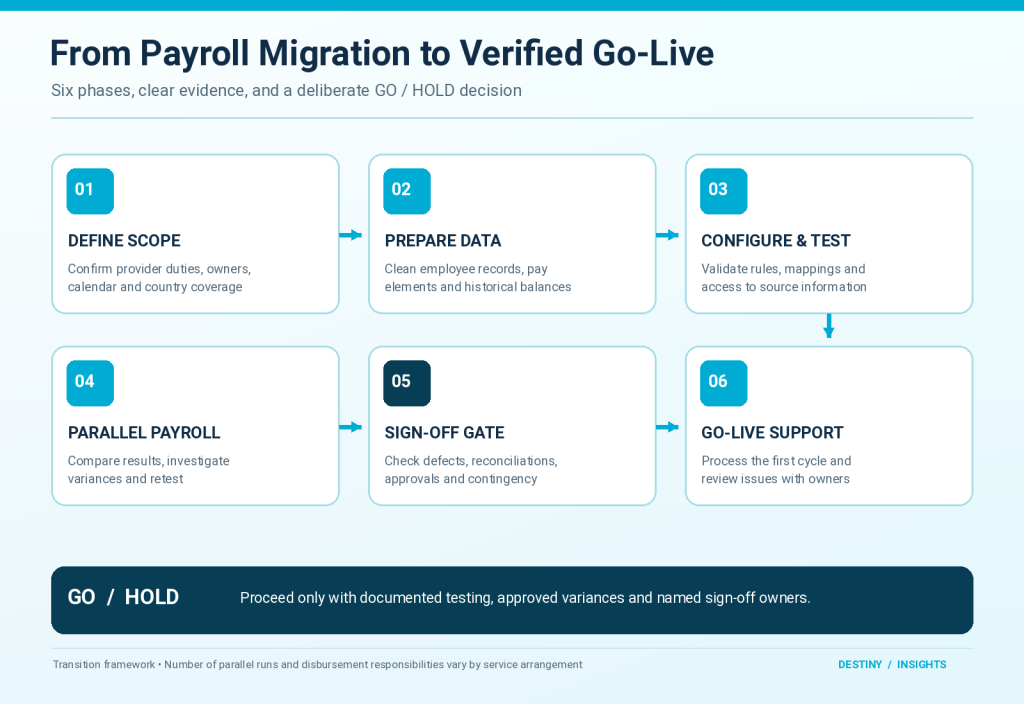
Phase 5: Decide whether the first outsourced payroll is ready
Go-live readiness is an approval decision supported by evidence. Establish what must be true for the first live cycle, who can accept a residual issue, and which defects require a hold. Not every numerical variance has the same impact; decision thresholds must be agreed for the organization rather than borrowed from a generic industry percentage.
| Readiness gate | Evidence required | Decision authority |
| Scope & data | Signed service scope, validated employees/pay elements, accepted opening balances | HR / payroll sponsor |
| Testing | Executed scenario results, variance register, material defects closed or formally accepted | Payroll owner |
| Controls & finance | Approved registers, funding/payment authorization path, finance reconciliation outputs | Finance sponsor |
| Service operations | Cutoff calendar, named escalation contacts, approved response procedures | Provider + client owners |
| Contingency | Hold / rollback steps, communication plan, first-cycle monitoring | Steering group / sponsor |
Use a simple decision record:
- PROCEED when required evidence and approvals are complete;
- HOLD when material pay or control risks remain;
- REMEDIATE AND RETEST when issues are fixable but not yet verified.
The number of parallel runs should be based on coverage, unresolved exceptions and organizational risk—not a fixed universal requirement.
A separate payroll service level agreement should define cutoffs, response obligations and raised expectations for this first cycle. Test those commitments in a realistic missed-input or urgent-correction scenario before the service starts.
Phase 6: Go live with first-cycle hypercare
The initial live cycle should have more explicit monitoring than a mature service. Assign named contacts for source-data issues, recalculation requests, approval delays, funding exceptions, employee inquiries and reporting differences. Keep an issue log with priority, owner, status and next update time.
After the cycle, reconcile the approved register to actual payments and accounting outputs as applicable, review unresolved inquiries and record what needs improving before the next payroll. In the United States, the IRS explains that payroll-tax responsibilities depend on the particular third-party arrangement and that an ordinary payroll service arrangement does not automatically remove employer obligations. Canadian employers should similarly check current CRA payroll deduction and remittance requirements relevant to their circumstances.
For U.S. arrangements, the IRS guidance on outsourcing payroll and third-party payers explains important distinctions among provider arrangements. For Canadian payroll, the CRA Employers’ Guide—Payroll Deductions and Remittances is a primary reference for employer processes. These sources should inform jurisdiction-specific review, not be treated as interchangeable rules.
A practical payroll implementation checklist before the go-live meeting
A transition meeting should result in a decision, not an optimistic status update. Ask the implementation team to show the following evidence before final authorization:
- Confirmed service scope, pay groups, legal entities and named responsibilities.
- Employee and compensation records have passed completeness and accuracy checks.
- Tested interfaces, file exchanges and rejected-record corrections.
- Reviewed and documented parallel payroll results and material variances.
- Payroll-to-finance reconciliation and approval evidence are available.
- Confirm funding/payment execution authority within the actual service scope.
- Agreed cutoffs, escalation contacts, fallback process and first-cycle support.
The workbook asks how an employer can simplify its process through outsourcing. The useful answer is not “move everything outside.” It is to replace ambiguous handoffs with agreed ownership, test evidence, explicit approvals and a repeatable service calendar.
The exact workbook query is “How can I simplify our payroll process with an outsourced service?” The transition framework above is the operational answer: simplify the handoffs and repeatable work without removing necessary review and authorization.
Your first outsourced payroll deserves a proper runway
Destiny’s HR and payroll outsourcing service can be evaluated against the processing scope, information handoffs, reporting and control requirements your organization needs. A service conversation should establish which responsibilities and transition activities can actually be supported in the relevant jurisdiction.
Start by comparing your implementation priorities with Destiny’s managed HR and payroll services, including the responsibilities your team intends to retain.
Make the First Outsourced Payroll a Verified Decision
A successful transition needs more than a date on the calendar. Define the test evidence, sign-offs and first-cycle service expectations with Destiny before moving forward.
Frequently Asked Questions
Confirm the service scope and owners, validate employee and pay data, test the information handoffs, perform parallel calculations, review variances, approve readiness and monitor the first live cycle.
It is a controlled comparison of results from the proposed payroll process against an agreed baseline for the same pay period. Investigate and retest material differences before the organization authorizes cutover.
There is no universal number for every outsourcing transition. Agree on test coverage and acceptance criteria, then determine additional cycles based on risks, material defects, data quality and the variety of pay scenarios.
Typically, employee master records, compensation components, pay groups, effective dates, deductions, relevant year-to-date balances and the fields required for reporting and reconciliation. The actual inventory depends on jurisdiction and service scope.
The employer should name authorized payroll, HR and finance decision-makers and document the provider’s readiness evidence. Contracted roles and internal governance determine the precise approval route.
It is an agreed period of enhanced support and monitoring during initial production cycles, with named escalation contacts, issue tracking, reconciliation and a review of service improvements.
