
 Rabeeka Siddiqui
Recruitment has become a data-intensive process. A single vacancy can involve requisition approvals, job descriptions, applications, resumes, screening, interviews, candidate evaluations, offers, and onboarding.
When these activities are spread across disconnected tools, recruiters can spend more time organizing information and coordinating tasks than assessing candidates. This is where AI in recruitment can help.
AI can assist recruitment teams with organizing candidate information, identifying relevant skills, supporting screening, and reducing repetitive work. However, AI alone does not create an effective hiring process. It needs structured candidate data, consistent workflows, useful recruitment analytics, and appropriate human oversight.
That is why a well-structured Applicant Tracking System (ATS) remains an important foundation for modern talent acquisition.
Why AI in Recruitment Needs a Strong ATS Foundation
An ATS provides structure to the recruitment process.
It can centralize candidate information, manage requisitions, track hiring stages, store resumes, coordinate interviews, maintain evaluations, and support offer management.
AI can add intelligence to parts of this process. helping teams work with candidate information more efficiently. But when candidate records are fragmented or recruitment workflows are inconsistent, AI has less reliable information to work with.
A stronger model is:
Structured ATS + connected candidate data + intelligent assistance + human decision-making
For organizations evaluating ATS software, this foundation matters as much as the AI capabilities themselves.
How AI Can Improve Talent Acquisition
1. Candidate Screening
Recruiters may receive hundreds of applications for a single role. AI-assisted screening can help organize candidate information and surface qualifications, skills, or experience that appear relevant to a vacancy.
This can help recruiters prioritize profiles for closer review. However, screening outputs should be treated as decision-support information, not as a substitute for candidate assessment. Hiring involves context, judgment, communication, and other factors that cannot always be reduced to keyword matching.
2. Candidate Matching
AI can help compare candidate information with job requirements and surface potentially relevant profiles from a larger resume pool. This can make existing candidate databases more useful when recruiters are searching for particular skills, qualifications, or experience. Recruiters should still review the context behind a suggested match rather than treating a score as a hiring decision.
Harmony’s talent acquisition environment provides centralized resume management, search capabilities, structured candidate evaluation, and best-fit analysis to help recruitment teams manage candidate information more effectively.
3. Recruitment Workflow Automation
Recruitment includes many repeatable activities. Requisitions need approval, interviews must be coordinated, candidate statuses need updating, and offers must be prepared and tracked.
Recruitment automation can help manage predictable workflow steps, while AI can assist with information processing and other intelligent tasks. Harmony supports structured requisition workflows, candidate tracking, interview scheduling, offer management, and recruitment notifications within its talent acquisition environment.
4. Better Recruitment Visibility
Recruitment leaders need more than applicant counts. They need to understand where candidates are in the process, how requisitions are progressing, and where delays or bottlenecks may be developing.
Useful recruitment reporting can include:
- Requisition status
- Candidate stages
- Hiring timelines
- Recruitment activity
- Source effectiveness
- Conversion rates
Harmony’s recruitment dashboards and hiring matrix provide visibility into requisition status, hiring timelines, and recruitment performance metrics, helping teams review activity across the talent acquisition process.
AI in Recruitment Should Support Recruiters
The purpose of AI in talent acquisition should not be to remove recruiters from hiring decisions. Instead, AI should help recruiters process and work with information more efficiently.
This distinction is especially important when AI influences candidate screening, ranking, or recommendations. Organizations should use consistent, job-related criteria, maintain appropriate human review, and monitor systems for inaccurate or unfair outcomes. They should also assess privacy, accessibility, and applicable employment requirements before and during deployment.
The UK Government’s guidance on responsible AI in recruitment highlights risks such as bias and digital exclusion, and recommends testing and ongoing monitoring. In the United States, the Equal Employment Opportunity Commission explains that existing anti-discrimination requirements also apply when employers use AI or other technologies in employment decisions. Although legal requirements vary by jurisdiction, these examples reinforce why governance and human oversight should be part of AI adoption.
The better model is straightforward: AI can help organize and assess information, while recruiters remain accountable for hiring decisions.
What Makes Harmony‘s ATS Different?
Harmony is more than standalone applicant tracking software. Its Talent Acquisition capabilities sit within a broader Human Capital Management (HCM) environment, connecting recruitment with other workforce processes.
Depending on the organization’s configured modules, the wider Harmony environment can connect talent acquisition with:
- Talent Management
- Performance Management
- Learning Management
- Compensation and Benefits
- Attendance and Overtime
- Leave Management
- Employee Self Service
- Workforce analytics
This connection matters because recruitment does not end when a candidate accepts an offer. The next steps include joining preparation, document collection, verification, and the transition into employee administration.
Harmony supports the transition from recruitment into onboarding through structured hiring workflows, pre- and post-hiring checklists, and document verification activities. This helps organizations manage recruitment and employee administration as connected stages rather than entirely separate processes.
When Should You Consider a More Advanced ATS?
An organization may need a more capable ATS or connected talent acquisition platform when its current recruitment process is difficult to manage, measure, or scale. Common signs include:
- Recruiters rely heavily on spreadsheets
- Candidate information is difficult to search
- Hiring managers lack visibility into recruitment progress
- Interview coordination consumes excessive time
- Hiring information is spread across multiple tools
- Recruitment metrics are difficult to produce
- Candidate information requires repeated data entry
- Recruitment and onboarding operate separately
These challenges may indicate that the organization needs more than another recruitment tool. It may need a connected talent acquisition process that brings candidate records, hiring activities, and onboarding workflows together.
Why Harmony HCM Fits Growing Recruitment Teams
Harmony combines applicant tracking with a wider HCM environment. Its talent acquisition capabilities support centralized candidate information, requisition management, configurable hiring stages, candidate evaluation, interview scheduling, offer management, recruitment analytics, notifications, onboarding workflows, and hiring records.
For organizations comparing ATS software, this connected approach can simplify the transition from candidate acquisition to employee onboarding. Rather than maintaining one environment for recruitment and another for wider HR processes, organizations can manage talent acquisition as part of a broader employee lifecycle.
A connected HCM environment also provides a more structured foundation for using AI in recruitment. Candidate information, workflows, analytics, and employee processes can be managed within a coordinated system, while the organization determines where intelligent assistance is appropriate.
What Should You Look for in an AI-Powered ATS?
Before selecting an AI-powered applicant tracking system, evaluate more than the AI label. Look at how the platform supports the full hiring process, how its intelligent features are governed, and whether it fits your existing HR environment.
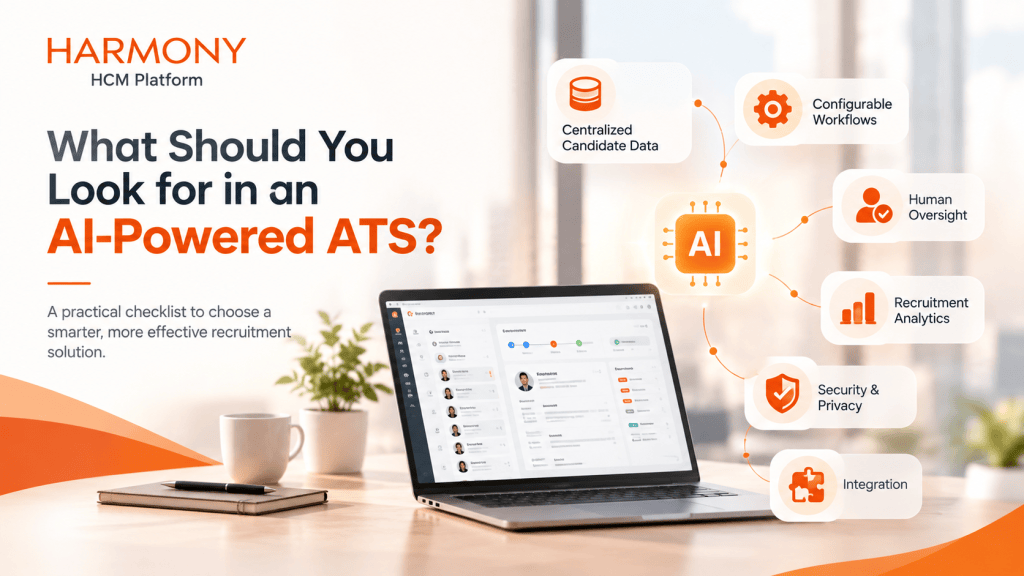
Look for:
Structured candidate data: Can candidate information be centralized, searched, and maintained consistently?
Configurable workflows: Can requisitions, interviews, evaluations, approvals, and offers follow controlled processes?
Human oversight: Can recruiters review, question, and override AI-supported recommendations where appropriate?
Recruitment analytics: Can the system show hiring activity, candidate stages, timelines, and process performance?
Security and privacy: How is candidate information accessed, stored, retained, and protected?
Integration: Can recruitment connect with onboarding and wider HCM processes?
The strongest recruitment technology combines intelligent assistance with structured workflows, appropriate oversight, and clear accountability.
Conclusion
AI in recruitment is changing how hiring teams organize candidate information, reduce repetitive work, and identify applicants whose experience may align with a role. But effective recruitment technology requires more than AI.
It also requires structured candidate data, consistent workflows, useful analytics, security, and responsible human decision-making. Without these foundations, AI features may add complexity rather than improve the hiring process.
Harmony HCM brings applicant tracking and talent acquisition into a wider HCM platform, helping organizations manage requisitions, candidates, interviews, evaluations, offers, onboarding, and recruitment analytics within a connected environment. For organizations moving beyond standalone applicant tracking software, this approach can provide a stronger foundation for modern talent acquisition.
Transform Talent Acquisition With Harmony HCM
Bring applicant tracking, recruitment workflows, candidate management, analytics, and onboarding together in one connected HCM environment.
Frequently Asked Questions
AI in recruitment refers to using artificial intelligence to assist with activities such as candidate screening, matching, information processing, and recruitment workflow support.
An AI-powered ATS combines applicant tracking capabilities with intelligent technology that can assist recruiters with candidate information, screening, matching, search, or other hiring activities.
Harmony supports requisition management, applicant tracking, centralized resumes, candidate evaluations, interview scheduling, offer management, recruitment analytics, notifications, and onboarding workflows.
No. Harmony is a broader HCM platform that connects Talent Acquisition with other workforce processes across the employee lifecycle.
AI should support recruitment rather than replace responsible human judgment. Organizations should maintain appropriate oversight when technology influences candidate assessment or employment decisions.
